



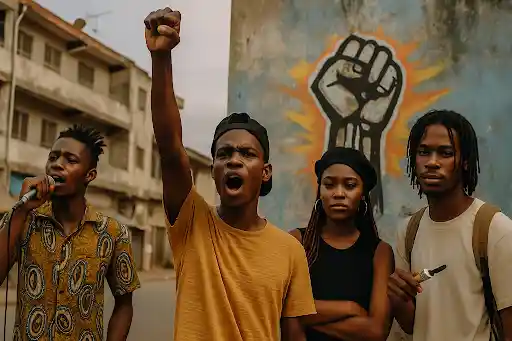
Many young Africans are standing up to the political systems in their countries. Civil-society campaigners are active on social media. They challenge the old guard using creative tools. These include rap, graffiti, and modern cultural symbols. They make for direct democracy. This helps build a more equal and decolonized society. Platforms such as 22Bet BD reflect how entertainment habits are changing. These youth movements show a bigger trend. They change how power and influence are viewed across the continent.
Hamidou Anne
Despite several significant and welcome advances, the African political classes have failed to build nations characterized by justice and progress. With no credible options from the opposition, politics has hit a low point. This deadlock is making many young people adopt a defiant stance. Their message is simple: “Every politician is like the next.”
Young people are discovering creative ways to get involved in politics. They’re creating startups, using online activism, and forming citizen groups.
None of these initiatives can replace politics. Politics remains the most potent tool for rewriting a nation’s future. It can stop inequalities and restore dignity to millions. A lot must be done quickly in Africa. Most importantly, we need to encourage a new dialogue among youth. This may involve different methods and players. The goal is to help them gain power democratically.
A new kind of political force is quietly growing and deserves close attention. Youth-led movements are emerging in urban centers and suburban neighborhoods. They are shaped by local culture and creative ideas. In Senegal, the rap collective Y’en a Marre (“We’ve had enough”) leads the charge. Burkina Faso has Le Balai Citoyen (“The People’s Broom”), sweeping away old systems. Meanwhile, in the Democratic Republic of Congo, groups like Filimbi and LUCHA. It is short for Lutte pour le Changement, or Struggle for Change, are pushing for reform from the ground up.
These civil society groups bring fresh air, breaking away from the tired, lookalike political elites. These new elites have a different way of speaking. Their messages are raw and straightforward. They use clear language that everyone can grasp. Their success comes partly from their actions on the ground. In 2011, Y’en a Marre pushed for voter registration. This led to a big turnout. In October 2014, Burkina Faso experienced an uprising. Following this, a symbolic street-cleaning took place. It was sparked by plans to change the Constitution. It aimed to let Blaise Compaoré, president since 1987, run for election again.
Decolonizing Politics
These new African icons are surprising. They break social norms by speaking, dressing, and expressing themselves. Their dress breaks away from the usual suit-and-tie look of politicians. Decolonization is a big challenge for politicians and the public. It focuses on a horizontal approach instead of a hierarchical one. This combines actual political action with a social stance. These youth movements are very political. They often disguise this fact with a ‘social’ label, whether they realize it or not. These groups don’t want government seats. They aren’t interested in running for office.
These movements aim to change politics with a decolonized view. They want to bring politics back to the people. This means giving power to citizens who have been left out of democracy. They were only asked to vote to approve decisions. What’s fascinating is that their internal structure already reflects the principles of direct democracy. Le Balai Citoyen uses local branches to let people nationwide join in decision-making. Y’en a Marre has a smaller horizontal reach, but its well-known leaders attract many. This makes it easy for everyone to join the consultation process. Traditional politics doesn’t allow for this kind of cross-cutting connection. The blend of modern citizen groups and traditional African negotiation methods shows how African political organizations can work.
These groups have proven their effectiveness. On June 23, 2011, in Senegal, Y’en a Marre sparked a vast movement. This happened despite police repression and watchful intelligence agencies. This stopped parliament from changing the Constitution. Those changes would have let Abdoulaye Wade run again. They also would have likely set up his son to take over when he left office.
Art at the Service of Politics
These youth movements unite people through music, dance, graffiti, and spoken-word art. They all share the same language and know the codes of their neighborhoods. On the streets and online, they ask for fresh talks and projects that let their dreams take off. These new players in African politics use various cultural references to back their actions. Rap music, for example, has been a strong way to share messages of resistance. They also promote native languages, like Wolof, used by Y’en a Marre, and Moré, embraced by Le Balai Citoyen. They also point out the Amílcar Cabral hat. Its name honors a leader who fought against Portuguese colonization in Guinea-Bissau.
These movements carry a heavy responsibility as symbols of hope. They represent bold, liberated political voices, untouched by colonial legacies. Thanks to them, the continent now brings to mind more than pity from poverty, famine, AIDS, and war. We stand at the edge of a truly transformative and liberating movement. Just as Spain’s Indignados movement led to Podemos in 2014, these groups could join national elections soon. We could see a decolonial shift with Western countries. This could lead to societies based on our own social and cultural realities.
