



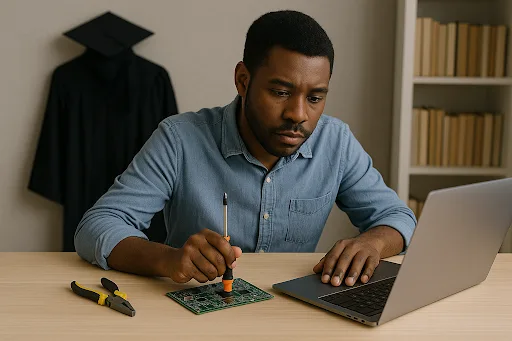
Walk into any café today and you’ll hear the same refrain drifting between the clatter of cups: “Forget the degree, can you actually do the job?” For decades, diplomas were golden keys—framed certificates hung proudly on living room walls, glowing like sacred relics. But the shine is fading. Employers are now rummaging less through resumes and more through actual ability. The world is quietly swapping diplomas for demonstrable skills.
The Crumbling Pedestal of Paper
Think of the degree as an ornate stage prop. It once dazzled, commanding applause before you even spoke your first line. But in a world where coding bootcamps churn out engineers in six months, and YouTube teaches everything from accounting hacks to drone piloting, that prop feels a little hollow. Employers increasingly want to see if you can perform the play, not just wave the ticket.

In fact, big players like Google, IBM, and even governments are cutting degree requirements for certain jobs. They’re asking: can you code? Can you design? Can you solve problems in real time without fumbling for the textbook? The academic robe is slipping, and in its place comes a toolbox.
From Ivory Towers to Digital Workshops
This isn’t an assault on universities. Knowledge still matters, context still matters, theory still matters. But the monopoly of the ivory towers has cracked. Today, a young woman in Yerevan can learn cybersecurity from online labs, build her first freelance portfolio on Upwork, and snag a global contract without a single polished parchment in hand. Skills travel. Credentials don’t always make it past customs.
The real revolution is in the speed of learning. A motivated 19-year-old in a small town can binge online tutorials, enter a hackathon, and emerge in six months with projects that rival what graduates spend years compiling. Meanwhile, carpenters, plumbers, and artisans are finding a digital stage too—TikTok carpentry channels are racking up millions of views, turning hands-on know-how into global proof of skill. Employers now quietly admit that someone who can show a portfolio of working apps, functioning machines, or even a viral campaign often trumps someone who just tells about it in a thesis. The walls of academia are not falling entirely, but doors and windows are swinging open, letting in voices that were once locked out.
Employers, battered by global crises and fast-moving markets, want workers who can hit the ground running. It’s less about the “four years in a lecture hall” and more about “can you fix this mess by Monday?”
And yes, sometimes, learning happens in the strangest corners of the internet. Just ask the community of gamers who claim they honed patience and probability judgment by studying odds at 20Bet, where practice often beats theory. Oddly enough, the digital playground is becoming a training ground, too. Skills are no longer just sharpened in libraries—they’re sharpened where people play.
The Global Puzzle of Proof
But here comes the snag: if the degree was the passport, what’s the new visa? How do you prove you can actually do something? Digital portfolios, micro-credentials, skill-badges, hackathon trophies—these are the new stamps of credibility. LinkedIn is starting to look like a carnival of badges, each one claiming, “Look, I can juggle data sets!” But credibility remains slippery. A skill is easy to claim and harder to measure.
Governments are cautiously stepping in. Some countries are experimenting with national skills passports, digital platforms where citizens upload proof of competencies—kind of like Pokémon cards, but for careers. Collect them all, and maybe you land the dream job.
The Human Side of Skills
Still, let’s not turn humans into glorified vending machines of ability. Skills without empathy, collaboration, or adaptability are like a screwdriver without a handle—technically useful but painful to wield. Employers quietly whisper that “soft skills” (a misleading term, really—they’re more like core skills) matter just as much. Can you manage conflict? Can you learn fast? Can you stay calm when Zoom collapses mid-presentation?
This is where the degree still carries some weight: it trains not just the hand but the mind. Yet the balance is shifting. We’re inching toward a hybrid model where degrees aren’t dead, but they’re no longer the king on the chessboard—more like a rook, valuable but not always decisive.
The Road Ahead: Less Paper, More Practice
So, is the world really heading toward a skills-first future? The signs point to yes. Job listings drop degree requirements like unnecessary baggage. Startups hire based on GitHub repos instead of GPAs. Communities form around shared practice, not shared diplomas.
But don’t bury the degree just yet. For medicine, law, and fields where mistakes cost lives, formal education remains the scaffolding. The shift isn’t about burning down universities; it’s about broadening the gates of opportunity.
Tools Over Titles
The truth is, the job market feels less like a university exam and more like a live cooking show. You’ve got half an onion, three spices, and an impatient audience—can you cook something edible? Those who can, regardless of whether they’ve spent four years in a lecture hall or four months in an online bootcamp, will likely define the future of work.
The world, it seems, is betting not on titles, but on tools. And maybe that’s not such a bad wager after all.
