


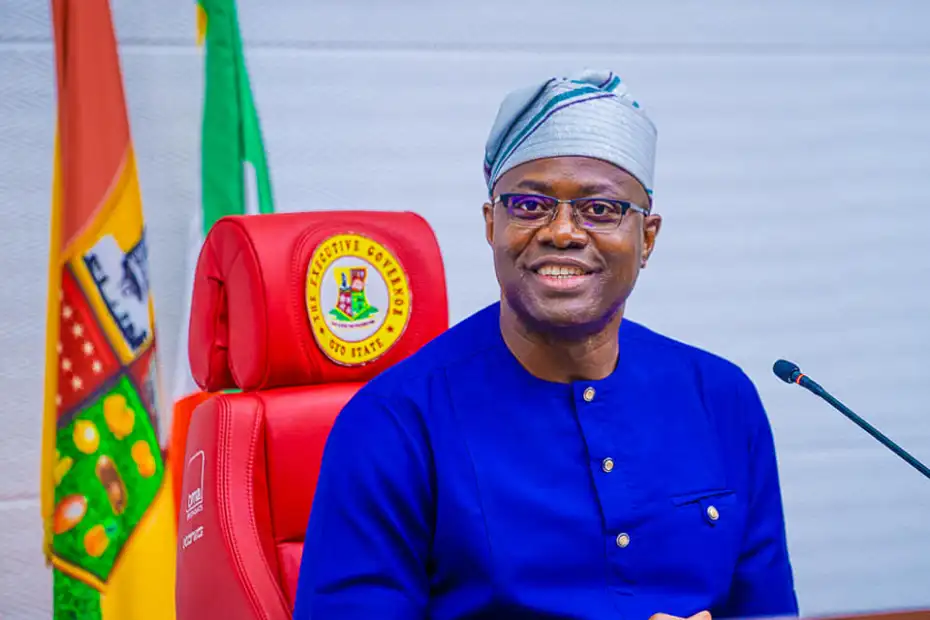
Oyo State Governor, Seyi Makinde, has presented the 2026 Appropriation Bill to the House of Assembly for legislative review and approval.
The budget proposal tagged Budget of Economic Expansion has an estimate of N891.985 billion.
Governor Makinde, while presenting the budget proposal at the House of Assembly Chambers, Secretariat, Agodi, Ibadan, said the proposed budget aimed at pressing further on the growth of the state economy, stressing that several flagship projects and ongoing investments have positioned Oyo State as a self-sufficient state that is ready for global market integration.
He noted that the capital expenditure of the budget proposal stands at N502.8 billion, representing 56.7 per cent, while N389.1 billion is allocated to recurrent expenditure, representing 43.3 per cent of the budget.
According to the Governor, infrastructure will get N210.02 billion, which represents 23.55 per cent of the total budget estimate, while the education sector will get N155.2 billion, representing 17.40 per cent, which is above the UNESCO recommendation for education.
He added that the health sector will get a total of N70.8 billion, representing 7.94 per cent, while agriculture will get N19.9 billion, which represents 2.24 per cent of the total budget.
Speaking on the expected revenues to drive the budget, Governor Makinde explained that the Internally Generated Revenue of the state has increased without increasing the tax burden on people, noting that this was made possible through the 2025 budget, which according to him, stabilised the economy for the growth of the state.
He said: “Mr Speaker, Honourable members of the Oyo State House of Assembly, today I stand before you to present the penultimate budget proposal by our administration, which we have tagged the ‘Budget of Economic Expansion.’
“Under our 2025 Budget of Economic Stabilisation, we consolidated on the economic gains from previous budgets.
“And so, for 2026, it is only logical that we press on further growth of the state’s economy.
“Mr. Speaker, several flagship projects and ongoing investments now position our state for a production-led economy. One of these is the Africa Continental Free Trade Area initiative. This will enable local producers to access the continent’s integrated markets. The next one is the Oluyole Free Trade Zone. This is designed to attract manufacturing, assembly plants, and export-oriented industries. Another one is the Special Agro-Processing Zones, SAPZ. This will transform primary agricultural outputs into higher-value products and boost agro-industrialisation.
“We also have the dry pot and logistics hub — this is strengthening Oyo’s competitiveness in trade and enhancing supply chain efficiency. And the upgrading of Samuel Ladoke Akintola Airport to international standards is positioning the state as a regional logistics and investment hub.
