



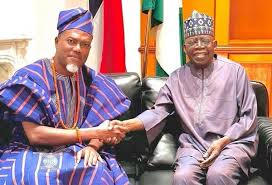
By Reno Omokri
As global economic and political leaders meet in Davos, Switzerland, to take stock of the world economy and chart its course for the 2026 financial year, I see some elements trying to misrepresent Nigeria’s economic situation and paint a picture of doom, when in fact we have been experiencing a boom.
It is so predictable that these individuals have refused to accept that under President Tinubu, Nigerian states and local governments are receiving their highest-ever allocations, both in Naira terms and in their dollar equivalents. All states are receiving double what they received under President Buhari, with some receiving even more.
Through the Federation Accounts Allocation Committee, President Tinubu disbursed the following sums to the 36 states:
January 2025: ₦498.49 billion.
February 2025: ₦593.70 billion.
March 2025: ₦562.19 billion.
April 2025: ₦530.45 billion.
May 2025: ₦556.74 billion.
June 2025: ₦577.84 billion.
July 2025: ₦607.41 billion.
August 2025: ₦660.41 billion.
September 2025: ₦709.83 billion.
October 2025: ₦727.17 billion.
November 2025: ₦789.12 billion.
For local governments, the following were disbursed:
January 2025: ₦361.75 billion
February 2025: ₦431.48 billion
March 2025: ₦410.50 billion
April 2025: ₦397 billion.
May 2025: ₦406.63 billion
June 2025: ₦419.97 billion
July 2025: ₦444.85 billion
August 2025: ₦485.03 billion
September 2025: ₦522.23 billion
October 2025: ₦529.95 billion
November 2025: ₦505.80 billion
Yet, when you, as a Nigerian citizen, do not have water, good local roads, standard nursery, primary and secondary schools, and effective healthcare centres, you blame President Tinubu.
You are a product of bad citizenship and follower-ship when you do that.
President Tinubu has already done his part by empowering your Governors and Local Governments. Their jobs are to manage the microeconomy, while President Tinubu oversees the macroeconomy.
And the President is doing a good job. Nigeria’s GDP growth rates for 2024 and 2025 were 3.4% and 4.1%, respectively. Meanwhile, the World Bank projects 4.4-4.6% growth for Nigeria in 2026 and 2027.
In less than two years, President Tinubu added $67 billion to Nigeria’s GDP, moving us from a ₦269.29 trillion economy on May 29, 2023, when he became President, to ₦372.8 trillion today.
It is also why Nigeria experienced a surge in foreign portfolio investment in 2025, with combined foreign investment reaching nearly $14 billion between Q1 and Q3 2025.
And on Monday, January 5, 2026, the total market capitalisation of the Nigerian Stock Exchange hit and crossed the ₦100 trillion mark for the first time ever, ending the day at ₦101.807 trillion.
In dollar terms, our capital market is now worth a whopping $67.8 billion!
The Naira’s value has stabilised, and petrol, which sold for ₦1,258.34 per litre at this period last year, today sells for between ₦699 and ₦739 per litre. Nigeria has the least expensive petrol in West Africa, the 5th most affordable gasoline in Africa, and the 10th cheapest fuel on Earth.
Nigeria’s inflation rate was 24.48% last year and is below 13% today, while our foreign reserves are poised to hit $51 billion this quarter.
As of January 2026, 864,000 Nigerian students have received NELFUND student loans, with disbursements totalling N161.97 billion for both tuition and upkeep.
And in terms of infrastructure, no nook or cranny of this country has gone untouched by the boom under Tinubu.
There have been 30 brand-new Federal Universities, polytechnics, and colleges either under construction or already approved in the two years of Tinubunomics.
Additionally, one of the most modern roads in Nigeria’s history is being constructed under Tinubu. I refer to the 750-kilometre Lagos-Calabar Coastal Highway being built for ₦15 trillion.
And contrary to lies being peddled by the likes of Nasir el-Rufai and co, the President has spread his developmental efforts all over Nigeria, especially in Northern Nigeria, where the following projects are outstanding:
The 1068-kilometre Illela-Sokoto-Badagry Superhighway at a price of ₦13 trillion
The Ajaokuta-Abuja-Kaduna-Kano (AKK) Gas Pipeline for $2.89 billion or ₦4.5 trillion
The Nigerian National Petroleum Company Limited (NNPCL) 1350 Megawatt (MW) Gwagwalada independent power plant (GIPP), a joint venture project estimated to cost $2 billion or ₦3.2 trillion
The Kano-Kaduna rail line at a price of $1.2 billion or ₦2 trillion.
The 465-kilometre Trans-Saharan Road being constructed at a price of an estimated $750 million or ₦1.2 trillion.
The 439-kilometre Akwanga-Jos-Bauchi-Gombe Road, which costs $1.33 billion or ₦2 trillion.
135 roads constructed or reconstructed by Nyesom Wike in the FCT at a cost of over $1.2 billion or ₦1.85 trillion.
Greater Abuja Water Supply Project, for $470 million or ₦750 billion.
The Kaduna Light Rail Project at an initial price of ₦100 billion.
International Conference Centre upgrade at a price of ₦39 billion.
So, instead of expecting President Tinubu to come to your house and build your toilet for you, the next time you experience bad roads in your state and local governments, or see a dilapidated school and hospital, or have no portable water in your community, instead of pointing a finger at the President, point it at your Governor and Local Government Chairman, then ask them what they are doing with all the trillions of Naira made available to them under Tinubu!
Reno Omokri
Gospeller. Deep Thinker. #TableShaker. #1 Bestselling author of Facts Versus Fiction: The True Story of the Jonathan Years. Hodophile. Hollywood Magazine Humanitarian of the Year, 2019. Business Insider Influencer of the Year 2022. 21st Most Talked About Person in Africa, 2024.
