



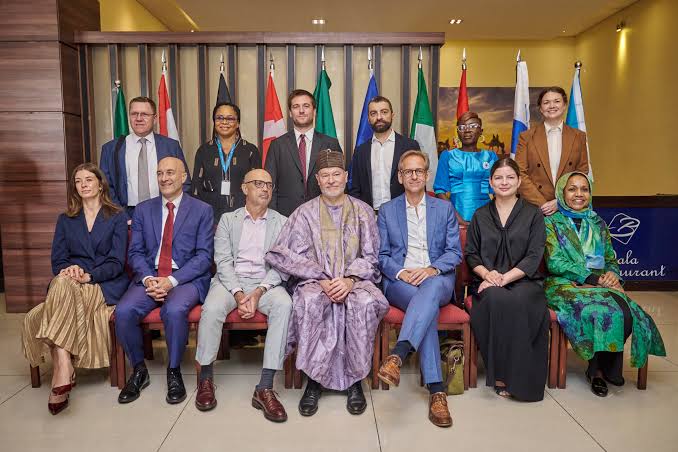
A powerful delegation of European Union (EU) Heads of Mission and major international development agencies has concluded a high-profile visit to Kano State, sharpening diplomatic and development focus on Northern Nigeria amid growing concerns over youth unemployment, urban pressure, and multidimensional poverty.
Led by EU Ambassador to Nigeria and ECOWAS, Gautier Mignot, the delegation—joined by UNICEF, GIZ, Plan International Nigeria, UN-Habitat, and other partners—spent several days in Kano engaging government officials, students, civil society actors, and media institutions in what officials described as a “strategic visibility and partnership mission.”

At the centre of discussions was Kano’s escalating development challenge: rapid urban growth, rising youth population, pressure on infrastructure, and persistent poverty indicators that continue to strain governance and social systems across the North West.
The delegation held talks with the Kano State Government, represented by Deputy Governor Murtala Sule Garo on behalf of Governor Abba Kabir Yusuf, where both sides discussed urban development, youth opportunity structures, and pathways for social inclusion.
Kano presented its Urban Development Strategy, a long-term framework designed to guide infrastructure expansion, strengthen planning systems, improve resilience, and expand economic opportunities across the metropolis, with technical backing from UN-Habitat.
The visit also underscored a clear diplomatic message from the European Union: deeper engagement beyond Abuja into Nigeria’s northern development corridor, where insecurity, unemployment, and education gaps remain persistent concerns.
Ambassador Mignot said the EU’s presence in Kano was a deliberate shift toward closer community-level engagement.
“This visit underlines the European Union’s commitment to being visibly present and engaged in Northern Nigeria. By connecting directly with communities, young people, and local institutions, we are strengthening partnerships that support inclusive growth, stability, and opportunity for all,” he said.
Across university halls and programme sites, the delegation engaged students at Bayero University Kano in discussions that reflected growing anxiety among young people over jobs, participation in governance, and access to opportunity.
Development partners used the mission to highlight ongoing interventions targeting some of the region’s most pressing social challenges.
GIZ Country Director, Dr. Markus Wagner, stressed that economic resilience in Northern Nigeria depends heavily on investing in young people and women through skills development and enterprise support.
Plan International Nigeria Country Director, Dr. Charles Usie, warned that access to education alone is not enough without measurable learning outcomes and sustained investment, particularly for girls facing systemic barriers.
UNICEF Nigeria Representative, Wafaa Saeed, reinforced the urgency of child-focused interventions, stating that survival, education, and protection must remain central to any development agenda targeting vulnerable populations.
The delegation also toured key intervention sites, including an accelerated education programme, a Qur’anic education integration centre supported by UNICEF, and a facility producing ready-to-use therapeutic food for malnourished children—underscoring the severity of child nutrition challenges in parts of the region.
Beyond social programmes, the delegation engaged with media platforms within the Kannywood industry, recognising the growing influence of local storytelling in shaping public opinion and driving social change.
The mission culminated in the Northwest Governors’ Forum Policy Dialogue on Reducing Multidimensional Poverty, where stakeholders renewed commitments to deeper collaboration between international partners and subnational governments in addressing structural poverty and inequality.
Analysts say the visit reflects a broader recalibration of international development engagement in Nigeria, with increasing attention shifting toward subnational regions where demographic pressure and economic vulnerability are most acute.
The EU and its partners say the focus now is on translating commitments into sustained programmes that expand opportunity for youth, strengthen education systems, and build resilient urban infrastructure capable of coping with Northern Nigeria’s rapid growth.
