


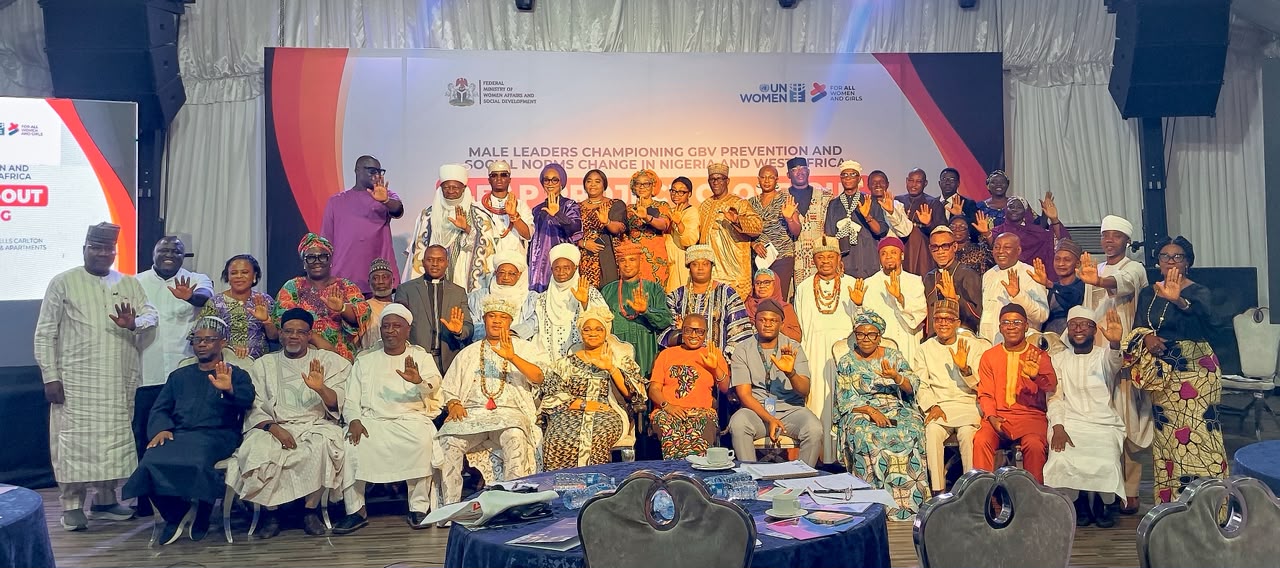
The Federal Government, UN Women and development partners on Monday, 29 june, 2026 declared traditional, religious and community leaders as indispensable allies in the campaign to end gender-based violence (GBV) and dismantle harmful social norms across Nigeria and West Africa, even as they announced a new regional initiative to tackle the growing threat of technology-facilitated violence against women and girls.
The commitment was reaffirmed at the close-out of the Leadership, Engagement, Advocacy and Prevention (LEAP) Project, a three-year Ford Foundation-funded programme implemented by UN Women to mobilise traditional and cultural leaders against GBV.
Speaking at the event in Abuja, the Minister of Women Affairs, Hajiya Imaan Sulaiman-Ibrahim, said sustainable progress in ending violence against women and girls would depend on the willingness of influential community leaders to challenge harmful cultural practices and champion gender equality.
She described traditional and religious institutions as powerful agents capable of transforming attitudes that perpetuate violence and discrimination against women and girls.
The minister stressed that changing harmful social norms required collective action beyond government interventions, urging community leaders to continue using their influence to promote dignity, justice and equal opportunities.
UN Women, however, said the conclusion of the LEAP Project marked not the end of the movement but the beginning of a broader regional campaign.
In remarks delivered on behalf of the UN Women Representative to Nigeria and ECOWAS, Beatrice Eyong, the organisation announced that the Ford Foundation had approved renewed funding for a new regional initiative titled “Community-Led Advocacy and Digital Spaces for the Safety of Women and Girls in West Africa.” The programme will be implemented in Nigeria, Ghana and Senegal and will build on the gains recorded under the LEAP Project by strengthening collaboration with traditional and religious leaders, community institutions and women’s rights organisations.
According to UN Women, the new initiative will also confront one of the fastest-growing forms of violence affecting women and girls—technology-facilitated gender-based violence—including online harassment, cyberstalking, image-based abuse and online exploitation.
The organisation said trusted traditional and religious leaders who had successfully driven change within their communities would now be equipped to promote safe, respectful and inclusive digital spaces, extending the fight against GBV from physical communities to the online environment.
UN Women also highlighted encouraging national data suggesting that prevention efforts were beginning to yield measurable results.
Citing findings from the 2024 Nigeria Demographic and Health Survey, the agency said the prevalence of sexual violence against women declined from nine per cent in 2018 to five per cent in 2024, while physical violence since age 15 dropped from 31 per cent to 19 per cent. Intimate partner violence also fell from 36 per cent to 23 per cent, and female genital mutilation declined from 20 per cent to 14 per cent over the same period.
Nevertheless, UN Women cautioned that declining rates of help-seeking among survivors underscored the need for stronger survivor-centred services, improved reporting mechanisms, psychosocial support and greater access to justice.
The organisation noted that over the three years of implementation, the LEAP Project helped traditional and religious leaders publicly reject harmful practices, strengthened partnerships between governments and traditional institutions, engaged more men and boys as allies, and established community accountability mechanisms that empowered women and girls to seek support. It also facilitated collaboration with Liberia, Sierra Leone, Senegal, Niger and Ghana in developing a Regional Accountability Framework for Traditional Leaders on Gender-Based Violence Prevention.
Stakeholders at the event maintained that while significant progress had been made, sustained investment in prevention, stronger partnerships with community leaders and continued regional cooperation would be critical to eliminating gender-based violence and ensuring that cultural and religious institutions become enduring champions of women’s rights across West Africa.
