


By Micheal Oluwagbemi, Abuja
On my recent domestic road trips and trans-Atlantic air trips, I used the long hours of solitude to catch up on a long list of books I had been in deficit of reading after two hectic years in public service that hardly gave me room to read or reflect over extended periods.
Solitude grants one’s soul such an irreplaceable opportunity to be nourished, and I am one who never shies away from taking such opportunities.
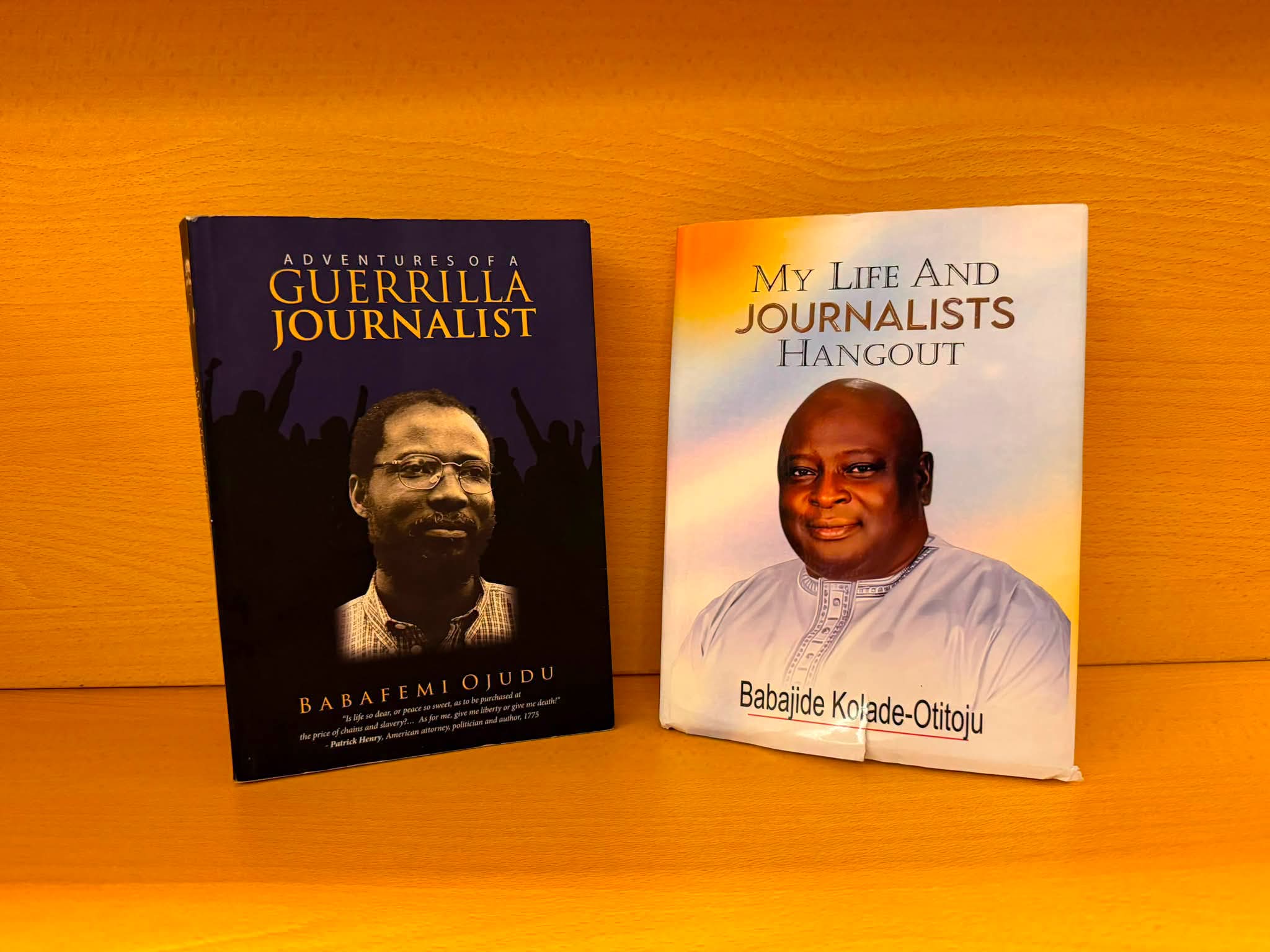
Coming at a period when I had just launched my new book, and coupled with a series of high-powered public events, the travel and solitude before, during, and after were a therapeutic balm to my soul. The books that I pulled off my shelves were written by two of my most celebrated mentors, who, between themselves, are also professionally related as former boss and employee: Senator Babafemi Ojudu and Babajide Kolade-Otitoju. SBO and BKO.
Both men hail from the hinterland of Ekiti, with family roots extending to their immediate western cousins in Ekinrin-Adde, Kogi State. They are as physically intimidating as they are intellectually sagacious. Both served at the temple of journalism—the hard investigative type—and SBO once employed BKO at TheNews, where the latter cut his teeth before achieving immense fame on Journalists’ Hangout on TVC.
BKO is a cloth cut from the old tapestry, no doubt. Fearlessly courageous and impertinently insightful, his book was a reading adventure, many of whose episodes arose from the military era, when the likes of Ojudu superintended over the risky venture of shining light into oppressive darkness.
It wove through an era when the men were boys, searching for news in one of the darkest periods of Nigeria’s history and staying dangerously close to annoying the men in jackboots, who brooked no nonsense from the pens of these impertinent young men that hounded them out of power sooner rather than later.
BKO, in a prose-like, gist-format narrative, regaled his readers with stories of brushes with the secret services, sourcing stories through the same security operatives, and repeatedly landing himself in trouble while barely escaping arrest, detention, and perhaps even death, as he served side by side with Bagauda Kaltho, who never got around to telling his own side of the story.
In the later part of the memoir, he described his rise through the ranks after leaving Kano and Kaduna, just about the time Nigeria was finding her feet in democracy once again. One could feel the energy of a young man who realised the once-in-a-lifetime opportunity to cover history in the making—not merely as a reporter, but as someone who now helped shape the newsroom, having proved himself during the darker years.
This second section of BKO’s book provides insight into the transition of journalism from activism to participation. From “gotcha” journalism to journalism that sought to influence governance from within, BKO was uniquely positioned to recount the true storytelling mechanisms of that period.
His unlikely rise in broadcast journalism, on a platform that often ran against the grain of the proprietor of TVC—who had been Governor of Lagos State and would later become President of Nigeria—sounded quite familiar, yet also served as a counterpoint to SBO’s own rise as a newspaper proprietor.
It was SBO and Bayo Onanuga, alongside a number of colleagues, who left Concord after refusing to withdraw a story against the military ruler, General Ibrahim Babangida, as ordered by their proprietor, Chief M.K.O. Abiola. Ironically, that same proprietor would later contest, win, and be denied the presidency in the annulled June 12 election. The struggle to reclaim that stolen mandate would eventually give birth to TheNews, the platform through which Ojudu would be repeatedly jailed, nearly lose his life, and witness many of his colleagues killed, detained, exiled, or relentlessly persecuted. Such is life.
The proprietor in SBO, who would not give in as a reporter to his own publisher on behalf of a military dictator friend—a dictator who would invariably contribute to the tragic fate of that same publisher—would later sacrifice the rapacious news editor in BKO to avoid libel suits and legal entanglements with Lagos State when they ran afoul of the “Landlord of Lagos,” who was both their friend and the emergent beneficiary of the democratic struggle they had so fiercely supported.
Well, in a democracy, you must be accountable, and you must also be willing to negotiate. I suppose President Tinubu, rather than hound the foxes of TheNews, decided instead to co-opt them in making TVC a better platform.
Today, one of SBO’s co-proprietors serves as a spokesman for the President. Though their relationship was briefly frosty—as I can personally attest—I think they have both decided to let matters rest, knowing full well that any exposé on their relationship with the Lion of Bourdillon may now be best written by yet another co-founder: the one who first jumped ship to establish City People when he realised just how dangerous the brand of journalism that both SBO and Bayo Onanuga insisted on foisting upon young, up-and-coming journalists like BKO had become at the turn of that era, now long gone.
SBO’s book, though rather excellently organised, save for a few mismatched titles and the opening page of the account of how he met my Aunty Tola, is a rich collection of stories from a rebellious man whose ideas have always been far bigger than his oversized stature. What no one can ever accuse SBO of lacking—professionally or politically—is courage. Throughout the book, his stories illuminate just what a tower of a man his immense courage made him.
Oga’s account of using his chairmanship of the NUJ Chapel at Concord to make M.K.O. Abiola uncomfortable, through his departure alongside his fellow travellers—Bayo Onanuga, Kunle Ajibade, Dapo Olorunyomi, Seye Kehinde, Idowu Obasa, and Sani Kabir, who handled the business and investment side—to establish TheNews, their enduring legacy, is woven throughout the pages of this memoir.
Written in a prose-like storytelling style, with each chapter capable of standing on its own, the book proves that, unlike BKO, SBO has not been corrupted by the free-flowing, opinion-driven journalism that thrives on television. He remains a disciplined newspaper man, and he writes like one.
Ojudu’s stories dwell generously on the military era and pay comparatively little attention to the post-democracy years, when he too, bitten by the bug of public representation, joined politics and left the discipline of everyday newspaper writing to the younger Turks represented by BKO. However, his account of Fayose and IGP Sunday Ehindero stands out as one that may well have driven this newspaperman to take a political stand—a decision that would eventually cause our own paths to cross many years later.
If their courageous brand of journalism, their instinct for stories, their willingness to become part of the stories they pursued as adrenaline-driven investigators, their physically intimidating presence, and perhaps even their shared ancestry are what bound SBO and BKO together beyond their inevitable boss-and-employee years at TheNews, then today they share the unfortunate fortune of both calling me their mentee, albeit in different ways.
For that, I am profoundly grateful.
That is how I came to read their memoirs first-hand, after having heard my fair share of these stories in one-on-one conversations, which both men generously shared with younger people like us who first came to know them through reading their writings and watching their broadcasts from afar, and who ultimately had the good fortune of meeting these two literary giants.
On this count, I certainly count my blessings, even as I bemoan their own misfortune of having to bear my incongruence as a mentee and admirer of their craft, now under serious threat as the world of journalism in Nigeria seems to have forgotten what it means to investigate and break scoops. I call it the dearth of investigative journalism, and I hope it is not yet its death.
For there is no doubt that I consider myself a failed journalist, but certainly one whose early introduction to the world of newspapers came through a father who thought the world of them; one whose first business, founded at the tender age of twelve, was a publication that I sold to my classmates; and one whose unending writing since the age of seventeen has only just found its way into publication.
I cannot end this review of these memoirs on journalism—the hard-nosed investigative type—written by two giants whom I proudly call mentors (and whom I had the privilege of honouring with the Presidential Distinguished Prize at the launch of my own book, shortly after assuming office as the 17th President of the Rotary Club of Abuja Metro), without bemoaning what we may be losing.
Who among today’s journalists is prepared to stand and be counted? Have journalists now become mere seekers of fortune rather than seekers of truth? Time alone will tell.
As I descend into Abuja after my 60-day odyssey across land, sea, rail, and the stage, I cannot help but wish we had more books like these so that the younger generation of changemakers can be inspired. I challenge more of the giants of Nigeria’s democratic era to write, no matter how imperfect their recollections may seem.
Our stories are too important to remain untold.
For, in the end, it is our stories that shape our destinies. Where are the SBOs and BKOs of my generation?
Michael Oluwagbemi writes from Abuja
