


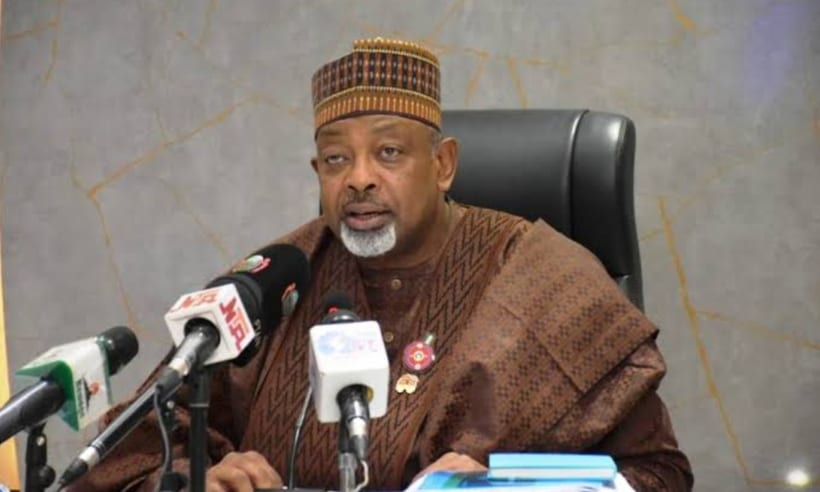
The Minister of Agriculture and Food Security, Senator Abubakar Kyari, has dismissed claims that Nigeria’s agricultural sector has suffered losses estimated at ₦5 trillion, describing the figures as inaccurate and unsupported by credible evidence.
Kyari, in a statement issued on Thursday, 19 November, 2026, said the claims of an annual ₦2.5 trillion loss and a projected additional ₦10 trillion loss did not reflect the current state of the country’s agricultural sector.
He cited the 2026 Wet Season Agricultural Performance Survey conducted by the National Agricultural Extension and Research Liaison Services (NAERLS), Ahmadu Bello University, Zaria, which reportedly put national cereal production at 29.393 million metric tonnes.

According to the minister, the figure represents a 1.84 per cent increase over the 2025 output, while rice production was estimated at 9.626 million metric tonnes.
Kyari said the figures contradicted claims that the agricultural sector was in general collapse, adding that the Federal Government had introduced several interventions to support farmers and boost domestic food production.
On the 150-day duty-free food import window introduced in 2024, the minister explained that the policy was a temporary measure intended to address supply shortages, improve food availability and moderate market prices.
He said the initiative expired on December 31, 2024, and had not been renewed or reintroduced.
The Minister listed some of the government’s agricultural interventions to include financing through the Bank of Agriculture, support from the National Agricultural Development Fund, mechanisation partnerships and the Special Agro-Industrial Processing Zones programme.
He also said the Federal Government had distributed 2.15 million bags of fertiliser to farmers across the country, while funding had been approved for the production and supply of more than three million bags of NPK fertiliser ahead of the dry-season farming period.
According to him, the planned fertiliser supply is expected to improve access to farm inputs and support domestic fertiliser production.
Kyari also highlighted the National Postharvest Systems Transformation Programme (NiPHaST), which he said was designed to address post-harvest losses through investments in storage facilities, warehouses and cold-chain infrastructure.
The Minister also disputed reports that more than 50 per cent of Nigeria’s rice mills had shut down, saying the claim did not reflect the overall situation in the country’s rice-processing industry.
He maintained that several rice mills remained operational and that the government continued to support local processors.
On food import policy, Kyari said the administration’s objective was to increase domestic production and reduce reliance on imported food. He also criticised a reported proposal by former Vice-President Atiku Abubakar to reopen Nigeria’s borders, arguing that increased food imports could expose local farmers to competition.
The Minister said the government remained committed to supporting farmers, strengthening local agricultural industries, increasing food production and reducing post-harvest losses.
However, the statement did not identify the source of the ₦5 trillion loss estimate or provide a detailed breakdown of the figures being disputed. It also did not include responses from the original claimants.
