



By Daniel Oluwatobiloba Popoola
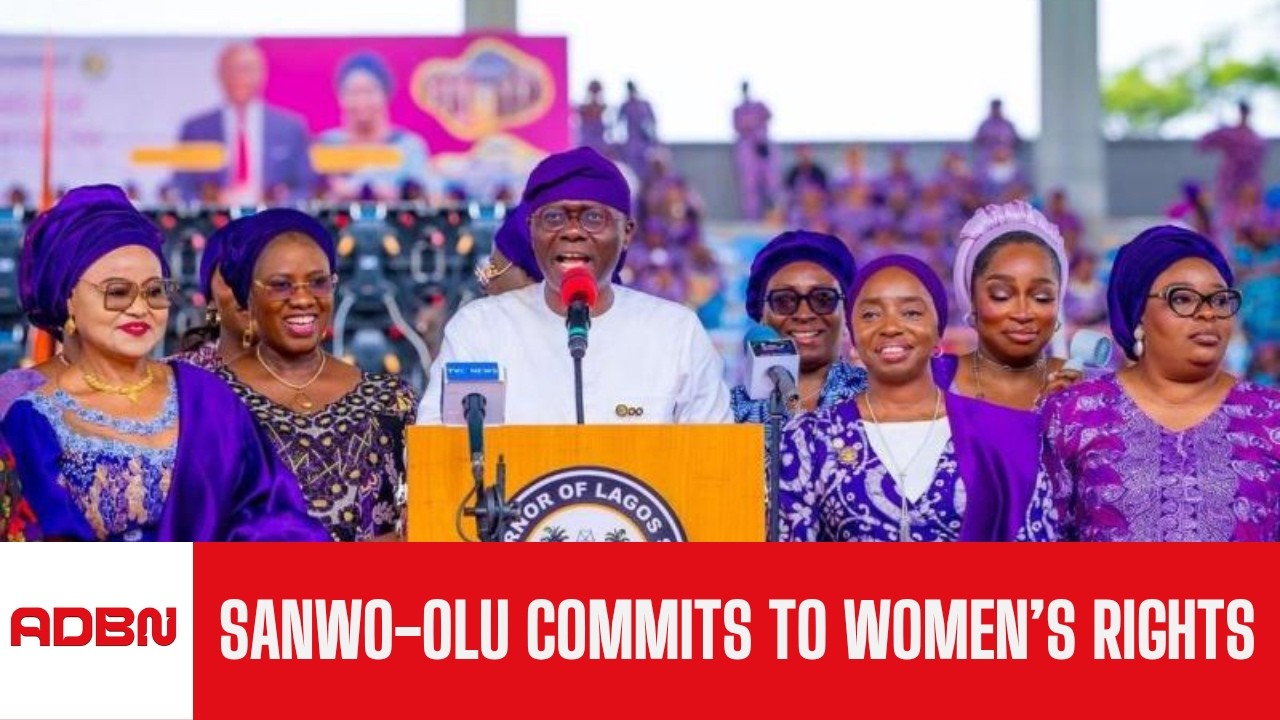
Lagos State Governor, Babajide Sanwo-Olu, has declared that sustainable development cannot be achieved without the full inclusion of women, warning that denying them opportunities, safety, and a voice undermines economic growth.

He made this assertion on Tuesday, 31 March, 2026, at the 2026 International Women’s Day celebration held at the Mobolaji Johnson Arena, where he aligned Lagos State with the global theme, “Rights. Justice. Action for All Women and Girls,” stressing that the theme demands accountability and measurable outcomes from governments.
Speaking at the event, Sanwo-Olu emphasised that gender inclusion remains a central pillar of his administration’s development agenda.
He noted that sustainable growth is unattainable where women are excluded, insisting that governance must be rooted in inclusion, justice, and sustained action.
“This theme is deliberate. It demands responsibility. It challenges governments to move beyond rhetoric and deliver measurable outcomes,” he said.
He further declared, “Sustainable growth cannot occur where half the population is denied opportunity, safety, or voice,” adding that women’s rights in Lagos are treated as legal obligations rather than mere aspirations.
The Governor, therefore, reiterated the state’s zero-tolerance stance on gender-based violence and discrimination, noting that efforts are ongoing to strengthen legal and institutional frameworks.
“Our position is clear: there is zero tolerance for injustice against women and girls. Justice must be timely. Justice must be fair. Justice must protect the vulnerable and hold offenders accountable,” he stated.
He added that the government would continue to invest in survivor support systems, legal enforcement mechanisms, and social protection structures to safeguard the dignity of victims.
Linking women’s empowerment to economic growth, Sanwo-Olu described the state’s interventions as strategic rather than charitable, noting that empowering women translates to broader societal gains.
“These are not charity efforts; they are strategic economic decisions,” he said. “When we give women economic opportunity, we gain inclusive growth. When we give girls the right environment to thrive, we gain innovation and long-term development.”
He explained that the state’s “Give to Gain” campaign reflects a governance model anchored on measurable social and economic returns, stressing that it is grounded in evidence and accountability.
Similarly, the Commissioner for Women Affairs and Poverty Alleviation, Bolaji Dada, said the celebration reinforced the state’s commitment to inclusive governance and sustainable development.
“Today, we are not merely marking a date on the global calendar; we are reinforcing a policy position, a governance priority, and a moral obligation,” she said.
Dada maintained that women’s rights are fundamental and non-negotiable, adding that the state has strengthened response systems to tackle domestic and sexual violence.
“Every woman and girl in Lagos State deserves to live free from violence, discrimination, exploitation, and fear,” she said.
She further stressed that economic empowerment is critical in reducing vulnerability among women, noting that poverty often exposes them to abuse and exclusion.
“A woman without income is more vulnerable to abuse, exclusion, and dependency. This is why poverty alleviation is central to our strategy,” Dada added.
According to her, the ministry has expanded skills acquisition, entrepreneurship training, and digital empowerment programmes to support women’s economic independence across the state.
Highlighting the broader impact of the initiative, she said, “When government gives protection, we gain safer communities. When we give access to skills and capital, we gain economic growth. The gain is collective, the gain is lasting, the gain is transformational.”
She also emphasised that inclusion remains a governance responsibility, not an act of charity, with targeted interventions for vulnerable groups, including rural women and persons with disabilities.
In her remarks, the guest speaker, Justice Atinuke Oluyemi, underscored the need to recognise and protect the inherent strength and rights of women.
“We are gathered here today to reaffirm the fact that rights must be protected,” she said, adding, “The majority of women and girls are actually born with female power.”
She urged stakeholders to translate discussions into tangible outcomes, noting that the ultimate goal is to address the real-life challenges confronting women and girls.
