


The Athena Centre for Policy and Leadership has blamed weak governance, poor financing and lack of institutional accountability for the persistent child malnutrition crisis in Northern Nigeria, warning that millions of children remain trapped in a cycle of hunger despite years of government nutrition policies and interventions.
In a new policy report released on Wednesday, 5 August, 2026, in Abuja, titled Why Malnutrition Persists in Northern Nigeria: Strengthening Nutrition Governance, Financing and Primary Healthcare, the Centre argued that Nigeria’s nutrition challenge is no longer primarily a policy problem but a governance failure that continues to undermine efforts to improve child health.
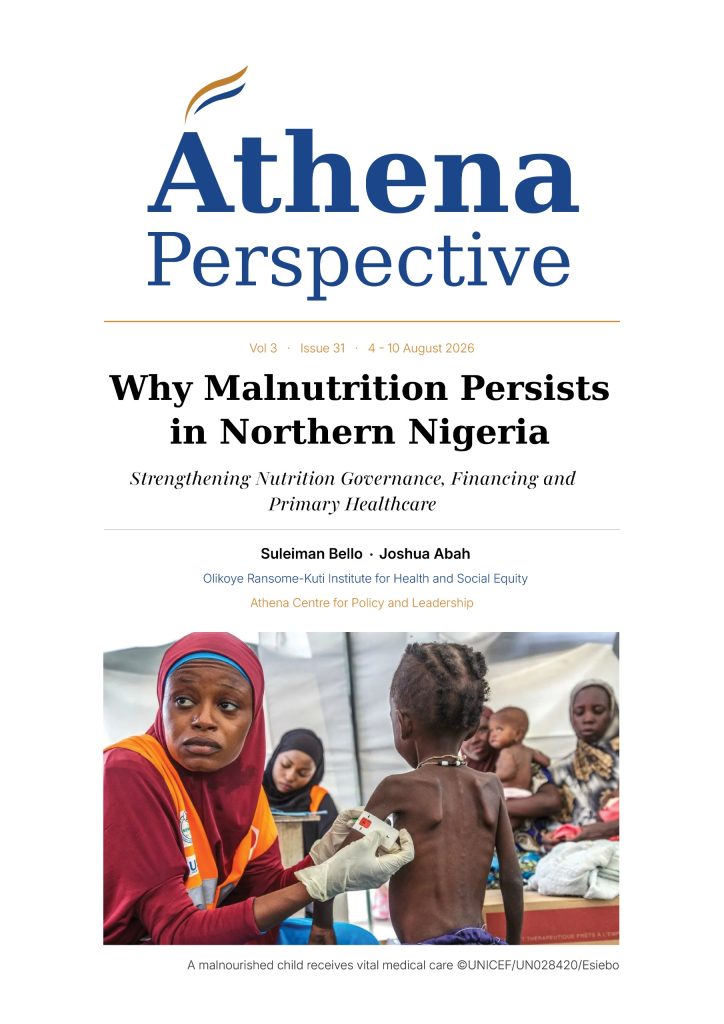
The report painted a grim picture of the country’s nutrition indicators, revealing that 40 per cent of Nigerian children under the age of five are stunted, eight per cent are wasted, while 27 per cent are underweight, with the situation considerably worse across the northern region.
According to the report, stunting affects 46.3 per cent of children in Katsina, 43.8 per cent in Sokoto and 42.6 per cent in Zamfara in the North-West. In the North-East, child food poverty affects 67 per cent of children in Borno, 66 per cent in Yobe and 60 per cent in Adamawa, underscoring the severity of the crisis.
The report also cited data from the World Food Programme showing that over 17 million people across nine conflict-affected northern states are currently experiencing crisis, emergency or catastrophic levels of hunger.
Authored by Dr. Suleiman Bello and Joshua Abah, the report acknowledged that Nigeria has developed several nutrition policies and identified proven interventions over the years, but noted that public institutions have consistently failed to translate those commitments into effective service delivery at community, ward, health facility and state levels.
It identified the absence of clear institutional leadership and accountability mechanisms linking nutrition financing, primary healthcare, agriculture, social protection and local implementation structures as major obstacles to reducing child malnutrition.
The report further criticised what it described as a reactive approach to nutrition management, arguing that government interventions are often activated only after children become severely malnourished rather than focusing on preventive measures during pregnancy and the crucial first 1,000 days of a child’s life.
To reverse the trend, the Athena Centre proposed four major reforms aimed at strengthening governance and accountability.
It recommended making verified nutrition preparedness a condition for accessing performance financing under the Basic Health Care Provision Fund in high-burden areas.
The Centre also called for the publication of a quarterly nutrition compliance ledger detailing budget releases, procurement of nutrition commodities, health facilities supplied, wards covered and outstanding government obligations.
In addition, it urged northern states to establish a lead nutrition accountability institution with authority to coordinate activities across the health, agriculture, water and sanitation, social protection, finance and humanitarian sectors.
The report also advocated strengthening Ward Development Committees to serve as frontline structures for identifying vulnerable mothers and children before malnutrition becomes life-threatening.
According to the report, nutrition must be treated as a measurable government responsibility rather than a humanitarian intervention triggered only after crises become visible.
It concluded with a stark warning: “A child should not have to become visibly wasted before the state becomes visible.”
Northern Nigeria has for years recorded some of the highest rates of child malnutrition in Africa, driven by a combination of armed conflict, displacement, widespread poverty, climate shocks, food insecurity and weak healthcare systems.
Despite successive national nutrition strategies and increased support from development partners, implementation gaps, inadequate funding, poor coordination among government institutions and weak monitoring systems have continued to limit progress, leaving millions of children vulnerable to preventable illness, impaired cognitive development and premature death.
The Athena Centre’s report adds to growing calls for governments at all levels to prioritise nutrition governance, improve accountability for public spending and strengthen primary healthcare as Nigeria works towards achieving the Sustainable Development Goals on hunger, health and child survival.
