



By Simbo Olorunfemi
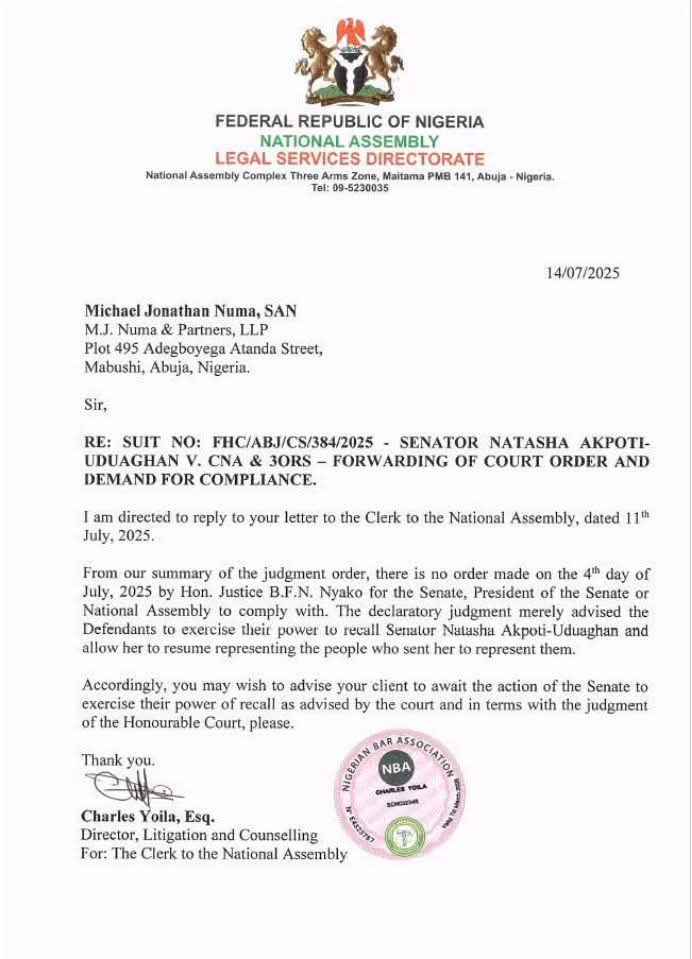
Much has been made of Justice Binta Nyako’s judgment in the case of Senator Natasha Akpoti- Uduaghan v The Clerk of the National Assembly of the Federal Republic of Nigeria and others. Many have argued that it is the ambiguity non-definitive and non-declaratory of the ‘judgement’ that has led to the confusion that has since then ensued, culminating in the embarrassing public spectacle we witnessed yesterday.

Having now taken time to review the full judgement, not just the extracts that first came out, I have come to a different conclusion on the matter. Rather, I am of the opinion that what we are dealing with is a case of contrived ambiguity and manufactured confusion. A dispassionate reading can only lead one willing to learn to clarity. There is nothing ambiguous or confusing in that judgement.
All that is needed is to situate the judgement in the proper context of the circumstances that led to the cause of action, pay attention to the reliefs sought by the plaintiff, bearing in mind that the Court is no Father Christmas, before reading the decisions of the court. That done, it becomes obvious that, but for a deliberate attempt at mischief, there is nothing that should have triggered the confusion that we have witnessed in the matter.
Dial back to the very beginning. The Senator has raised hell on the floor of the Senate about the reassignment of seats, insisting on speaking from a seat not assigned to her, holding on to Order 10 of the Senate rules. Every effort, within and outside the chambers, to make her understand that while Order 10 does offer her the privilege to speak at ‘anytime’, that privilege is itself contingent upon her speaking from her assigned seat, in accordance with the rules.
She not only refused to abide by the rules on the day, she followed up with a radio interview. A motion was subsequently moved by another Senator stating that his privilege has been breached, leading to the matter being referred to the Committee on Ethics and Privileges, which then invited her to appear before it. Rather than do so, she opted to approach the Court.
She approached the court seeking for the protection of her right to fair hearing and privileges under Orders 9, 10 and 11, arguing that a combined reading of these orders ought to have served as cover for her actions on the floor of the Senate and protected her from being referred to the Ethics and Privileges Committee.
In other words, her suit was virtually a carryover of her argument on the floor of the Senate, and subsequently in public fora, that by virtue of Order 10, she had a right to speak from wherever. It is on the basis of, and around this, that she filed an action seeking 6 reliefs.
It is instructive that the Court didn’t find merit in any of the reliefs sought by the Senator, comprehensively ruling in favour of the Senate, asserting its rights to set its rules, discipline its members, that the Senate President is vested with the right to assign and reassign seats, affirming that members can only speak from assigned seats, and that it is within the rights and purview of the Senate to refer the Senator to the Ethics and Privileges Committee.
In the words of the court (CAPS mine for emphasis):
“In the circumstances of this case, as rightly contended by the Defendants, an invitation to appear before an Ethics Committee of the senate is a CLEAR MANIFESTATION OF PROCEDURAL FAIRNESS, NOT A BREACH OF IT. From a careful reading of the Originating Summons, there exists no allegation whatsoever to the effect that the Defendants contravened a statutory or constitutional provisions as the crux of this action is hinged solely on protection of parliamentary privilege on the floor of senate. It cannot be the intendment of Section 36(1) of the 1999 Constitution that this Court has powers to entertain complaint against any and every discussions / written communication arising from plenary sessions of the 2nd defendant If it were the case, then this Honourable Court would know no rest.”
Safe to say that the Court resolved all the issues raised in favour of the Senate (even partly affirming the argument raised by the Senate in its preliminary objection on lack of jurisdiction). Even on the matter of Contempt filed by the Senate President on 5th May, 2025, seeking 5 reliefs, the Court in protest at the 27th April, 2025 Satirical apology by the Senator, the Court found the Senator guilty of contempt, fined her and ordered her to issue public apology.
There is therefore no confusion, from the judgement as seen, that all the direct reliefs sought by the Senator were denied and orders to that effect expressly made.
Justice Binta Nyako might have simply wrapped it up, but it is my opinion that having reviewed the rules of the Senate and out of consideration for the Constituents, she then ventured further to offer an opinion on the extensive powers of the Senate, which allows it to suspend a member ad infinitum. Bear in mind that there was no relief directly sought to this effect. The Court only decided to widen the scope of consideration, and in that light, she argued that “to make a LAW THAT HAS NO END IS EXCESSIVE and cannot be the intendment of the law”, thus imploring to EXERCISE ITS POWER to review the rules and also recall the Senator.
These are the words of Justice Binta Nyako in that regard. (CAPS mine for emphasis) :
“On the issue of denial of the Plaintiff to the representation of her senatorial District without inspiring the function of the NASS, I will give and say due to the gravity of the issue, I have read in its entirety, the Senate Rules under which the Plaintiff was suspended thus denying the representation of her senatorial Districts.
“I believe that the constitution, Legislative House (Powers & Privileges) Act nor the Senate Rules will not intend for that to happen. I have read with interest, chapter ix (8) of the Senate Rules and Section 14(2) of the Legislative House (Powers & privileges) Act ix (8) allows the Senate to suspend a senator until a time determined by the senate ad infinitun) while S.14(2) allows for suspension of a member (Senator) in similar terms even without pay.
“I do not think the constitution envisages this.
“A Senator is expected to represent his people in either Legislative house for a specific number of days per session. If any suspension is UNWARRANTED, then I OPINE that the Act and the Senate Rules should also be specific and not live it at large. A suspension cannot exceed the requisite number of days the member should sit. The constitution says a legislative vear is 181 davs and the house-should sit for this number of days. This makes it at least 36.2 weeks in a year which is a session. To suspend a member for 6 months means suspension for 180 days and this is half the number of days the member is expected to sit in the House representing his people.
“I do not think this is the intention of the framer of the law. To make a LAW THAT HAS NO END IS EXCESSIVE and cannot be the intendment of the law. I AM OF THE OPINION that the senate has the POWER TO REVIEW this provision of the Senate Rules and even amend Section 14(2) of the Legislative Houses (Powers & Privileges) Act both for being over reaching. The senate has the power to and I believe should recall the plaintiff and allow her to same-time, represent the people who sent her there to represent them.”
It is my belief that what the Court did was to, out of compassion, offer a lifeline to the Senator, in realisation that this was a difficult situation. The Court has clearly established the powers of the Senate and that it has not contravened its rules and the law in this instance. The Court AFFIRMED THE POWER OF THE SENATE to discipline its members, but then ADVISED the Senate to EXERCISE THAT POWER to REVIEW its rules and RECALL the Senator.
I believe that offering the opinion that the Court should exercise its power to recall the Senator was the Court’s way of asking the Senate to temper justice with mercy.
I believe that if that judgement had been accepted with a bit of contrition and humility and there had not been the rush to foist a different interpretation on it as obvious to some of us who have read it, reading into the decision of the court what was not there, we might not be where we are today. I believe a more diplomatic approach might have served as a lifeline for a rapprochement between the Senator and the Senate.
An apology to the Court, as ordered, and an apology to the Senate, as had been requested by the Senate, could have followed suit, and that would have offered an opportunity for a dignified closure to this phase of an embarrassingly mismanaged fight.
I do not see how enlisting the services of social media influencers and full-time activists can help turn a recommendation to an order.
There is a time for everything. No matter how far gone one might have in one direction, there is always an opportunity to beat a retreat, rethink and restrategise.
Postscript:
At this point, the Senate will do well to pull a plug on this, and let her back into the chambers unconditionally
I expect that as soon as it resumes, it would go into a closed session, debate this and take a decision to have her back.
Even though there is a precedent of the Senate extending the period of suspension, as was the case under the leadership of Senator Saraki in the case of Alien Ndume, who was out for 8 months, in this case, it would serve the Senate and everyone else to put an end to this drama.
Outstanding matters in court and pending petitions can be made to run the full course.
Hopefully, lessons have been learned.
