


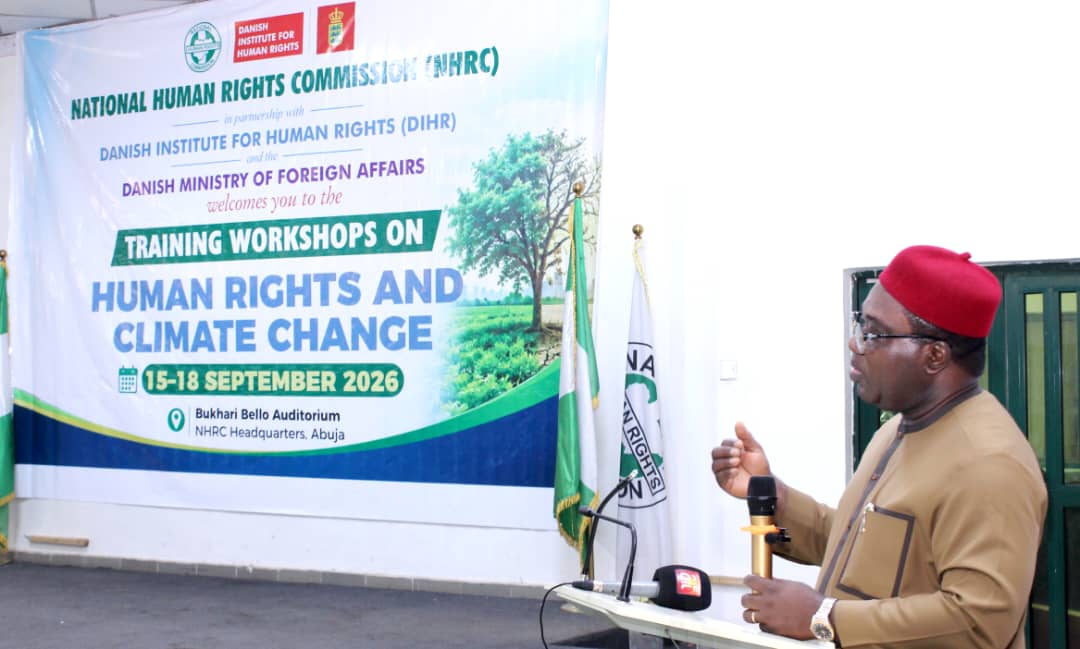
The National Human Rights Commission (NHRC) has raised concerns over the growing impact of climate change on human rights in Nigeria, warning that flooding, drought, extreme heat, displacement and food and water insecurity are increasingly threatening the dignity and livelihoods of vulnerable communities.
The Commission’s Executive Secretary, Dr Tony Ojukwu, gave the warning on Tuesday in Abuja at a two-day staff training workshop on Human Rights and Climate Change, organised by the NHRC in partnership with the Danish Institute for Human Rights.
Ojukwu said climate change could no longer be treated merely as an environmental or development issue, stressing that its consequences were increasingly being felt through violations of fundamental rights.
He identified women and children, persons with disabilities, older persons, farmers, rural communities, internally displaced persons and other vulnerable groups as among those facing disproportionate risks from the changing climate.
“Climate change is no longer simply an environmental or development concern,” Ojukwu said, noting that its effects were being experienced through flooding, drought, desertification, extreme heat, changing rainfall patterns, food and water insecurity, displacement and loss of livelihoods.
He said the NHRC had responded by establishing a dedicated Climate Change Unit following a 2025 academic conference on Climate Justice, jointly hosted by the Commission, the Raoul Wallenberg Institute and the University of Nigeria, Nsukka.
According to him, the unit was created to ensure that climate considerations were integrated into the Commission’s monitoring, investigations, complaints handling, research, human rights education, advocacy and policy engagement
The NHRC boss also disclosed that the Commission had inaugurated a National Working Group on Climate Change and Human Rights, bringing together government institutions, civil society organisations and other stakeholders.
The group includes the National Council on Climate Change and the Federal Ministry of Environment and is co-chaired by the two institutions.
Ojukwu said the initiative reflected the Commission’s recognition that the human rights consequences of climate change could not be effectively addressed by a single institution.
He explained that the current training was designed to strengthen the capacity of NHRC staff across the country to identify, document and respond to climate-related human rights violations.
The participants include Climate Change Focal Officers from the Commission’s 36 state offices, the Abuja Municipal Office and various departments at its headquarters.
He described the officers as a critical component of the Commission’s response architecture because of their proximity to communities directly experiencing the effects of climate change.
“You are often closest to the communities and individuals who experience the effects of climate change,” Ojukwu told the participants, urging them to use their positions to identify emerging rights concerns and ensure that affected communities receive appropriate institutional attention.
He said the Commission expected the focal officers to become centres of knowledge, coordination and action within their respective areas of responsibility.
Ojukwu, however, stressed that the officers would not be expected to work in isolation, noting that effective climate action required cooperation among government agencies, communities, civil society, development partners and academia.
He said the Commission would follow up on action plans to be developed by participants during the training, emphasising that the programme should translate into measurable interventions rather than remain a theoretical exercise.
“We do not want participants to leave this auditorium with knowledge that remains only in notebooks or presentations. We want to see that knowledge translated into action,” he said.
The Executive Secretary said a pre-training survey had already helped the Commission identify climate-related vulnerabilities and human rights concerns across states, adding that the findings would be used to develop practical and context-specific action plans.
He said the Commission would monitor implementation, identify challenges, share good practices and provide additional technical support after the training.
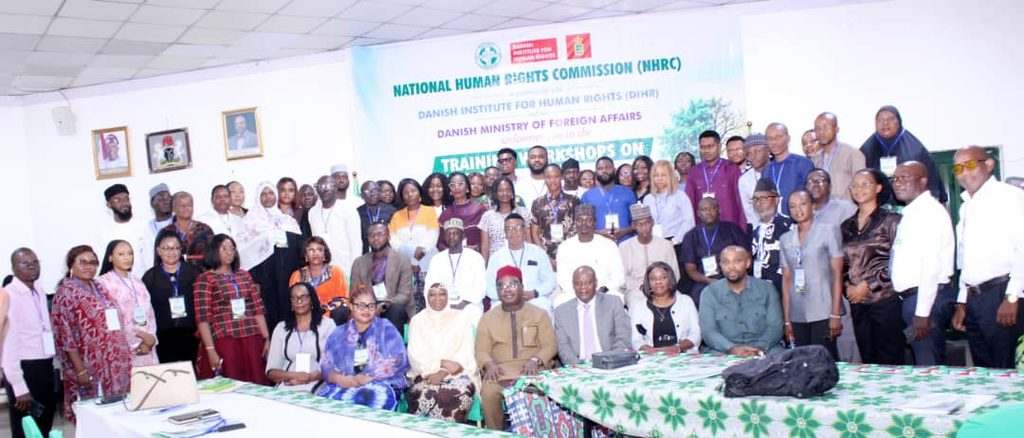
Earlier, Chief Advisor at the Danish Institute for Human Rights, Maria Paul Peterson, said climate change was increasingly undermining development gains and the enjoyment of economic, social and cultural rights.
Peterson, who spoke on “Climate Change and Human Rights,” said the climate crisis should be viewed through the lens of human rights, equality, accountability and justice, rather than solely as an environmental problem.
She observed that the consequences of climate change were unevenly distributed, with communities and countries that had contributed least to global climate change often suffering some of its most severe consequences.
She urged National Human Rights Institutions to strengthen their response to climate-related rights violations through data collection, documentation, evidence gathering, public awareness and human rights education.
Peterson also identified advocacy for stronger climate policies and legislation, handling complaints from affected individuals and communities, and influencing government climate initiatives as key areas where human rights institutions could make a difference.
She stressed the importance of strengthening the capacity of such institutions to understand the intersection between climate change and human rights and to respond effectively to affected populations.
The two-day training, holding at the Bukhari Bello Auditorium of the NHRC headquarters in Abuja, also features facilitators from the Network of African National Human Rights Institutions (NANHRI) and the Nigerian Meteorological Agency (NiMet).
Ojukwu commended the Danish Institute for Human Rights for its technical support, recalling that the partnership had earlier produced a general staff webinar in July attended by more than 300 NHRC staff.
He said the high participation in the webinar demonstrated growing recognition within the Commission that climate change must increasingly be understood as a human rights issue.
The Executive Secretary said the NHRC’s ultimate objective was to build a network of officers capable of monitoring, identifying, investigating, documenting and reporting climate-related human rights impacts while ensuring that affected communities had access to participation, justice and effective remedies.
He added that the Commission also sought to ensure that human rights principles were reflected in climate policies, programmes and responses across the country.
The workshop therefore places climate change firmly within the NHRC’s broader mandate of protecting human dignity, with the Commission seeking to move from documenting the consequences of climate-related disasters to influencing policies and responses that protect vulnerable Nigerians.
Bauchi Hosts ACReSAL’s Additional Financing Mission
By Segun Adewale in Bauchi
The Bauchi State Government has pledged to scale up climate-resilient agriculture and restore degraded lands as it hosted a Hybrid Additional Financing Pre-Appraisal Mission of the World Bank-supported ACReSAL project in the state.
The state Governor, Senator Bala Abdulkadir Mohammed, represented by his Deputy, Rt. Hon. Mohammed Auwal Jatau who was speaking at the opening ceremony of the event held at the Sir Ahmadu Bello International Conference Centre, Bauchi on Monday, 14 September, 2026, said the engagement was more than a funding discussion.
According to him, “It is a sounding call to strengthen our partnership with the World Bank and other global initiatives towards solving multi-dimensional climate change issues, particularly across hard-to-reach communities”.
The Bauchi Governor said the proposed additional financing will target agro-climatic resilience. Key areas include the restoration of over 9,000 hectares of degraded land, institutional strengthening of the Ministries of Agriculture, Environment and Water Resources, and expanded support to vulnerable communities through youth engagement and revolving fund schemes.
He added that the state will also deploy 100 all-terrain vehicles for agricultural extension services, establish new field offices, and procure equipment for erosion control and land restoration.
“This is about giving our rural people the tools to testify about the impact of these projects on their well-being,” the Governor stated.
The Federal Government also commended Bauchi’s performance under ACReSAL – Agro-Climatic Resilience in Semi-Arid Landscapes. National Project Coordinator, Mr. Abdulhameed Umar, described the project as “performing,” a rating he said triggered the move for additional funding across 19 northern states and the FCT.
“Bauchi happens to be one of our best-performing states as far as ACReSAL is concerned. We didn’t find it difficult to come to Bauchi because ACReSAL is actually being implemented and delivering results here,” Umar said. He conveyed greetings from the Ministers of Environment, Agriculture and Water Resources.
Task Team Lead of ACReSAL, Dr. Joy Iganya Agene also praised Governor Mohammed’s leadership.
“His Excellency is one of the leading governors under ACReSAL who understands donor funding and the required support,” she said, and urged the state to improve further under the new funding window.
ACReSAL, launched in Bauchi in May 2023, focuses on landscape restoration, climate resilience and improved livelihoods in semi-arid areas.
Dr. Agene said the push for additional financing at mid-term, following a review in Lagos in May/June, reflects strong performance by participating states.
Officials said the mission will review the scope of the additional financing and assess implementation arrangements ahead of final World Bank approval. Jatau assured partners of the state’s political will and counterpart funding to ensure timely delivery, as technical sessions on project design, safeguards and community engagement continue this week.
