


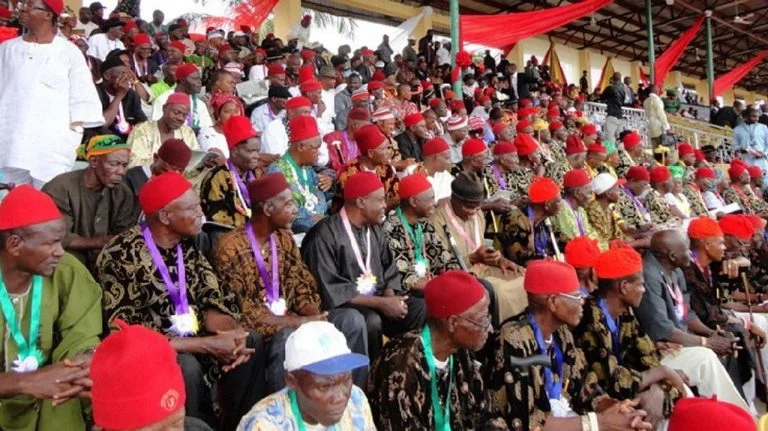
The Federal Government has moved to curb the controversial installation of “Eze Ndigbo” in foreign countries, backing a sweeping decision by Ohanaeze Ndigbo Worldwide and South East traditional rulers to abolish the practice outside Igboland, following a series of international incidents that have strained Nigeria’s diplomatic relations.
Minister of State for Foreign Affairs, Bianca Odumegwu-Ojukwu, delivered the government’s position at the high-level Imeobi meeting of Ohanaeze in Enugu on Thursday, 9 April, 2026, describing the proliferation of Igbo “kings” in the diaspora as a growing embarrassment to Nigeria and a trigger for avoidable conflicts abroad.
She warned that while diaspora communities are free to promote their culture, attempts to replicate traditional rulership structures in foreign lands have repeatedly sparked tensions with host authorities and local populations.
The latest flashpoint occurred in East London, where the coronation of Solomon Ogbonna Eziko ignited violent protests. The unrest led to the destruction of property, attacks on foreign-owned businesses, and clashes with security forces, after locals interpreted the installation as a challenge to South Africa’s traditional authority system.
South African institutions, including the Eastern Cape House of Traditional and Khoi-San Leaders and the Department of Cooperative Governance and Traditional Affairs, declared the coronation illegal, underscoring the diplomatic sensitivity of such actions.
Nigeria’s foreign missions quickly distanced themselves from the development, with officials clarifying that the event was merely cultural and not a recognized monarchy. The Nigerian Embassy in Pretoria subsequently issued an apology and urged citizens to maintain a low profile.
Odumegwu-Ojukwu revealed that similar tensions had surfaced in Accra in 2025, where protests against Nigerians escalated over the same issue. She led a diplomatic delegation to calm the situation, engaging directly with John Mahama and other key stakeholders.
According to her, the intervention of the Ghanaian president was pivotal in diffusing tensions, as he reaffirmed his country’s commitment to ECOWAS protocols on free movement and rejected calls for xenophobic actions against Nigerians.
The minister stressed that such crises place Nigerian lives, businesses, and diplomatic standing at risk, insisting that urgent measures were necessary to prevent further escalation.
In response, Ohanaeze Ndigbo Worldwide has formally proscribed the conferment and use of “Eze Ndigbo” titles outside Igboland. President-General of the organization, Azuta Mbata, declared that any individual assuming such a title abroad does so without the backing of the Igbo people.
He disclosed that the group would notify state governments and Nigerian missions globally of the decision and is working with traditional rulers to establish sanctions for violators, including community-level enforcement through hometowns and town unions.
The Federal Government has pledged to reinforce the directive through its diplomatic channels, signaling a coordinated effort to prevent further international disputes linked to cultural misrepresentation.
The development marks a decisive shift by both the government and Igbo leadership to separate cultural expression from traditional authority in diaspora settings, amid growing concern over the global implications of local customs.
