


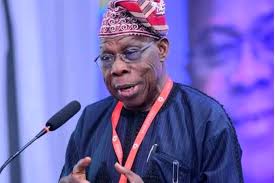
By Daniel Oluwatobiloba Popoola
Former President, Olusegun Obasanjo, has said Africa’s decades-long underdevelopment stems largely from leadership failure, declaring that the continent’s promise can only be realised through honest, courageous and transformational governance.
He spoke on Wednesday, 4 March, 2026 in Abeokuta while delivering a colloquium titled Burden and Blessing of Leadership: “Reflections from Global Africa to the World,” held as part of activities marking his 89th birthday. Born on March 6, 1937, Obasanjo used the platform to reflect on Africa’s stalled progress, his personal leadership journey and his continued relevance at 89.
“Africa is not a problem to be managed but a promise to be fulfilled through honest, courageous, selfless, incorruptible and transformational leadership,” he said.
Highlighting what he described as the continent’s unrealised potential, Obasanjo argued that Africa’s challenges were neither geographical nor historical but the result of governance deficits.
“By every measure of natural endowment, Africa should be a continent of prosperity, stability, peace, security and global influence,” he stated. “Instead, a major part of the continent remains a theatre of preventable disease and suffering, starvation, conflict, insecurity and poverty.”
According to him, the primary cause is “the failure of those entrusted with power to lead for the people and serve them rather than against them; to build institutions rather than subvert them; to welcome accountability rather than flee from it, to ensure equity and justice rather than enthrone injustice, inequality and inequity.”
He warned that many leaders assume office with reformist zeal but soon derail.
“The same young reformer who promised accountability begins to silence the press, harass the judiciary, and intimidate civil society. All institutions become perverted only to serve the interest of the leader, his family, political accomplices and business interests,” he said.
To bridge what he termed the leadership gap, Obasanjo stressed the need for deliberate leadership formation.
“We must invest not only in teaching leaders what to do, but in forming leaders who are constituted and imbued with attributes and values to do the job the right way,” he said, urging young Africans to take democracy seriously and commit to accountable, transparent governance.
“A continent that fails its youth does not merely waste a generation; it plants the seeds of instability that will haunt the next several generations,” he cautioned.
Reflecting on the burdens of leadership, the former President described the loneliness and moral weight of decisive moments.
He recalled commanding the Third Marine Commando Division days before the end of the Nigerian Civil War in January 1970.
“My troops were positioned for the final push. Hundreds of thousands of Igbo civilians were trapped, starving, dying,” he recounted.
“On one side was the imperative of ending the war quickly to stop further suffering. On the other was the risk that a military advance would deepen the humanitarian catastrophe. No textbook told me what to do. No senior officer was going to make that call. It was mine alone. I made it. We saved lives by not shelling Owerri. History has rendered its verdict.”
He further reflected on the weight of public expectation upon his election as President in 1999 after years of military rule.
“When I was elected President in 1999, the Nigerian people had endured years of military dictatorship, economic stagnation, and institutional decay. They did not elect a president, some of them thought; they elected a miracle performer. And when the miracle did not arrive in full measure overnight as it never can I could hear the murmurs of some of them. This is the burden: to be elevated by hope and measured by time, often simultaneously,” he said.
Obasanjo also spoke of the cost of principle, recalling his incarceration under the late Head of State, Sani Abacha.
“True leadership requires the willingness to hold a position when it is unpopular, to say no when yes would be more convenient, to name a truth that powerful interests wish suppressed,” he said.
“This costs friendships. It costs alliances. It sometimes costs your freedom as I learned in the prison under Sani Abacha, where I was held for three and a half years, tried before a kangaroo tribunal, and very nearly executed.”
Yet, he noted that leadership also carries blessings, citing achievements such as Paris Club debt relief and the establishment of the Economic and Financial Crimes Commission to recover stolen public funds.
“The blessing of having done the right thing when doing the wrong thing would have been easier. That is the first blessing of leadership: the opportunity for moral self-definition. Not who others say you are,” he said.
In his closing remarks, Obasanjo dismissed rumours of his death circulating in a fake letter, insisting that he remained strong at 89.
“They publish and circulate a fake paper credited to me that I am writing, giving notice of my death, pafuka. That is their wish and surely not God’s wish for me,” he said.
“God has assured me that He has more for me to do on earth, and He has given me the wherewithal to do it.
I dey kampe as usual.”
