


By Segun Adewale in Bauchi
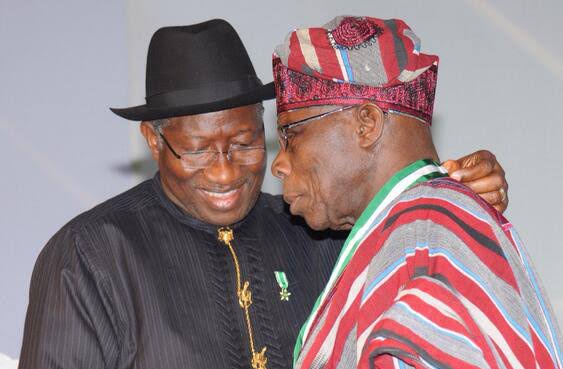
Former Nigerian Presidents: Olusegun Obasanjo and Goodluck Ebele Jonathan; alongside Bauchi State Governor, Senator Bala Abdulkadir Mohammed and NDC Presidential Candidate, Peter Obi have called for a renewed commitment to strengthening democratic institutions, protecting the rule of law and rebuilding public confidence as Africa confronts growing challenges to democratic governance.
The call was made on Tuesday, 11 August, 2026, at the 2026 Goodluck Jonathan Foundation Democracy Dialogue, held at the Sir Ahmadu Bello International Conference Centre in Bauchi, under the theme: “Beyond Elections: Can Political Parties and the Judiciary Save African Democracy?”
Chairing the high-level dialogue, former President Olusegun Obasanjo emphasized that Nigerian and African politics requires strong political parties and an independent judiciary, stressing that elections alone cannot guarantee democratic survival and progress.
Obasanjo argued that the survival of democracy in Africa depends on institutions that are strong enough to withstand political pressure and leaders who are prepared to submit themselves to the principles of accountability and constitutional governance.
He stressed the need for political parties to embrace internal democracy, accountability and responsible leadership, while urging the judiciary to remain independent, impartial and courageous in upholding justice and protecting democratic values.
The former President said elections remain vital to democracy but cannot, on their own, guarantee freedom, fairness, accountability, effective governance or public trust.
He challenged political parties to move beyond personality-driven politics, ethnic and regional mobilisation, and mere electoral competition, urging them to become schools of democracy and engines of policy innovation.
Former President Goodluck Jonathan, founder of the Goodluck Jonathan Foundation, warned that the erosion of democracy rarely happens overnight.
He explained that democratic systems can gradually deteriorate when institutions are weakened, constitutional principles are ignored, political power is abused and citizens lose confidence in the political process.
Former President Goodluck argued that African countries should examine democratic models suited to their respective histories and realities, while limiting excessive presidential power through stronger institutions, independent judiciaries, and effective checks and balances.
He maintained that elections, although fundamental to democracy, cannot by themselves guarantee democratic stability.
According to him, democracy must be sustained by credible institutions, respect for constitutional order, responsible political actors and citizens who have confidence that their voices matter beyond election day.
Governor Bala Abdulkadir Mohammed, in his contribution, echoed the need for a broader understanding of democracy, emphasizing that democratic governance must extend far beyond the casting of ballots.
He stressed that political parties must become more accountable, transparent and responsive to the people, while the judiciary must remain strong, independent and fearless enough to defend the rule of law without intimidation or political interference.
The Governor commended the Goodluck Jonathan Foundation for consistently providing a credible platform for intellectual engagement on the challenges confronting democracy in Nigeria and across the African continent.
He noted that sustained dialogue among political leaders, academics, civil society actors and other stakeholders remains essential to strengthening democratic institutions, encouraging peaceful political transitions and developing practical solutions to emerging threats to democratic governance.
Also speaking,the presidential candidate of Nigeria Democratic Congress(NDC), Peter Obi also questioned the democracy being practiced in Nigeria and other African countries, saying that institutions of government required overhaul.
Peter Obi, also criticided Nigeria’s judiciary saying it is helping destroy democracy.
He said, “I’m surprised that I have to make remarks, but I have to start by thanking our former President for this consistency in dialogue and discussing democracy. It portrays you as a true democrat, which you’ve lived since you left office. And I thank our host for this wonderful thing.”
He added,”As somebody who benefited from Nigerian democracy and judiciary, I was just talking to somebody seated here, a judge of Supreme Court, who, as Justice of the Supreme Court, who I never met in my life, but they wrote the judgment that made me Governor.”
The NDC Presidential candidate added, “We just turned around here and said, where will you get that type of judgment in Nigeria today? It is impossible. I never met her. I met her two years after being Governor, and he tapped me and said, I am just such a social person. But he wrote my judgment. I was in court for three years, challenging my election.”
According to him, “Five Justices that I never met, one day gave judgment in my favor. It cannot happen in Nigeria today. I went to Court of Appeal, five judges I never met, gave judgment in my favor. So if you look at that and look at what is happening today in Nigeria, where Professors are now aiding illiterates to rig election, where our lawmakers have removed forgery as an offense in electoral matter, a Senior Advocate of Nigeria (SAN), defending forgery.”
He added, “Our religious leaders are now praying for criminal politicians for blessing. We have a crisis, and above all, our judges are now singing on your mandate will stand. So it is a big, and all of us, unexamined life is not worth living.”
Peter Obi stressed that,”It is time for every Nigerian to sit down and ask ourselves, where is our nation going? We need to reverse this, because the abuse we are allowing today will take its revenge on our children. God bless all of you.
In a keynote address, Prof Karuti Kanyinga, Research Professor of Development Studies at the Institute for Development Studies (IDS), University of Nairobi warned that African democracy is being hollowed out from within because ruling parties and opposition parties have become almost indistinguishable,
Prof. Kanyinga said the continent’s political crisis is driven less by ideology and more by money and weak capacity.
“We have never seen the difference in how they govern*,” the Professor of Development Studies at the Institute for Development Studies, University of Nairobi, told delegates.
“I’m tempted to argue that even opposition political parties, when they get into office, lack the capacity to deliver. The difference between opposition parties and government is that they are all political parties. They are essentially the same.”
Under the theme “Beyond Elections: Can Political Parties and the Judiciary Save African Democracy?”, he said the blurring of lines is deliberate in some countries.
“In some countries, parties leading elections and those in opposition are the same. The first thing the opposition hears is a knock on the door from government asking, ‘Can we come in? Can we have an alliance?’ That minimizes the role of political parties.”
Prof. Kanyinga accused parties of double standards on democracy. saying “They demand internal democracy from governments while failing to practice it themselves. They conduct their own party elections.
They nominate candidates by themselves. They don’t give ordinary citizens a voice. You already know who will get the ticket in the next election, whether the people want them or not. That is the tragedy of our political parties.” He said.
He identified the rising cost of elections as the biggest barrier to credible competition, saying it has turned politics into a business for the wealthy and shut out women, youth and independent candidates.
Citing examples from Nigeria, Kenya and Ethiopia, he said: “In Nigeria, a seat in the House of Representatives requires not less than ₦500 million. In Kenya, it’s about $300,000. To contest for Governor, you need close to ₦2 billion.”
‘That pressure forces aspirants to rely on private businesses.
“The moment you use private businesses to support you, and the moment you win, they capture your policies,” he warned.
“The ideological differences that defined political parties in the past no longer exist. You can no longer tell what a particular party stands for.”
Prof. Kanyinga also raised concern over the courts, saying judicial independence is under threat across the continent.
“The judiciary can intervene and adjudicate with ease. But the problem is that courts across the continent have become commodified,” he said.
He quoted a saying from his region: “Why hire a lawyer when you can buy a judge? Why waste your money?”
The result, he said, is a two-tier justice system.
“Access to justice is only possible for those with money and political power. That has ruined judicial independence in many parts of the country. The courts are no longer upholding the rule of law.”
He concluded that without reforms in party financing, internal party democracy and judicial independence, elections will keep producing governments that look different on paper but govern the same in practice.
The GJF Democracy Dialogue brought together policymakers, civil society and academics to assess democratic governance in Africa beyond election cycles.
The dialogue brought together an influential gathering of political leaders, diplomats, academics and representatives from different parts of Africa.
Among the prominent personalities in attendance were former Vice President Namadi Sambo; former Anambra State Governor and NDC presidential candidate Peter Obi; former Plateau State Governor Jonah Jang; and Bayelsa State Governor, Senator Douye Diri.
The high-level discussions ultimately underscored a fundamental message: Africa’s democratic future cannot be secured by elections alone. It requires credible political parties, an independent judiciary, accountable leadership, resilient institutions and citizens who trust the democratic process.
As democratic systems across the continent continue to face institutional and political pressures, the Bauchi dialogue has reinforced the urgency of moving from election-centred democracy to a deeper culture of constitutionalism, accountability, justice and good governance.
