


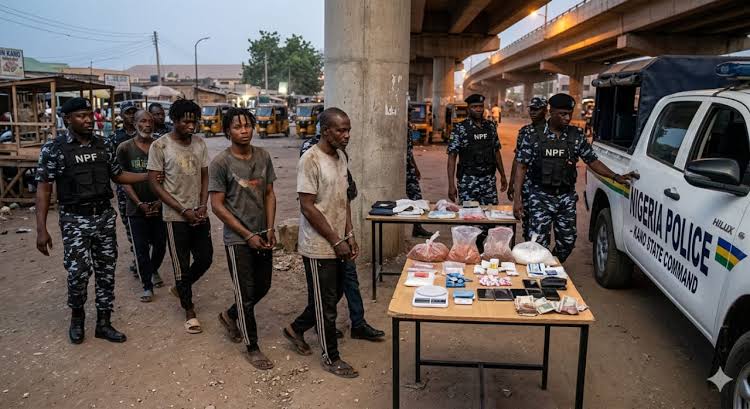
Drug abuse and trafficking are responsible for over 70 per cent of major crimes in Kano State, exposing the deep-rooted link between narcotics and the persistent wave of thuggery known locally as Fadan Daba.
This is disclosed in a confidential police report obtained by PRNigeria, which also revealed that drug abuse has become a major enabler of organised thuggery groups, which often engage in violent clashes, armed attacks, and street fights across Kano.
The report, compiled by the Kano State Police Command under Commissioner of Police CP Ibrahim Adamu Bakori, disclosed that 3,081 suspects were arrested for major offences in 2025, with the majority linked to drug-related activities.
The findings paint a troubling picture of a state where illicit drug networks are not only thriving but also fuelling violent crimes, leading to deaths, injuries, and destruction of property.
In a rare move, the Command deployed a crowdsourcing strategy using open-source intelligence to map suspected drug networks across the state.
Through its Public Relations Unit headed by CSP Abdullahi Kiyawa the police published two mobile numbers on social media, inviting residents to submit names and addresses of suspected drug dealers.
The response was overwhelming.
A total of 513 names were received from across all 44 Local Government Areas of Kano State, with some individuals reportedly mentioned multiple times—suggesting entrenched and widely recognised drug networks operating within communities.
Police sources told PRNigeria that the list is currently undergoing verification and analysis for possible enforcement action.
The report noted that the volume of submissions reflects a growing willingness among residents to collaborate with law enforcement in tackling drug abuse and trafficking.
“This initiative has shown that communities are aware of the problem and are ready to support efforts to address it,” a senior police source said.
However, the document warns that without decisive intervention, the situation could deteriorate further.
“If this menace is not confronted with all seriousness, the crime rate in Kano State will continue to escalate, posing a significant threat to public safety,” the report stated.
Investigations revealed the organised thuggery groups, commonly associated with Fadan Daba, are reportedly sustained by drug distribution networks that provide both funding and operational support.
To address the crisis, the police have proposed establishing a Multi-Agency Task Force to coordinate enforcement and intelligence operations.
According to the report, the task force would include personnel from the Nigeria Police Force, National Drug Law Enforcement Agency (NDLEA), Neighbourhood Watch, Vigilante Groups and Other relevant security agencies.
The proposed body would be mandated to identify, arrest, and prosecute drug traffickers, dismantle supply chains, and target individuals linked to both drug dealing and violent thuggery.
The report emphasised that enforcement alone would not solve the problem and called for a broader strategy that includes prevention, awareness, and rehabilitation.
Key recommendations emphasised the need for a comprehensive, statewide public awareness campaign to educate citizens on the dangers of drug abuse, alongside deeper engagement with traditional rulers, religious leaders, and community stakeholders who play critical roles in shaping public behaviour. Participants also stressed the importance of establishing functional rehabilitation programmes to support drug addicts on the path to recovery, while strengthening intelligence‑gathering mechanisms to detect and disrupt drug‑related activities more effectively.
The discussions underscored the urgency of reviewing existing drug offence laws to reflect current realities and ensure stronger deterrence. In addition, stakeholders proposed establishing mobile courts to expedite the prosecution of drug‑related cases, thereby reducing delays and reinforcing accountability within the justice system.
While the police have pledged to liaise with the Kano State Government and other stakeholders to implement the recommendations, findings by PRNigeria indicate that a coordinated, state-wide response is yet to fully materialise.
Security experts say the convergence of drug abuse and youth unemployment has created a volatile environment, where criminal gangs recruit easily and operate with increasing boldness.
A Fellow of the Centre for Crisis Communication (CCC), Mukhtar Yau Madobi, warned that failure to act swiftly could allow drug networks to become further entrenched, worsening crime and undermining public safety.
“The report underscores a critical reality: drug abuse is no longer just a public health issue in Kano—it is a central driver of insecurity,” Madobi added.
As the state grapples with rising crime and youth-related violence, the success or failure of proposed interventions may determine whether Kano can reverse the trend or slide deeper into a cycle of drug-fuelled instability.
By PRNigeria
