


By Oluwole Solanke, PhD, FCIB
Nigeria is once again standing at a crossroads of national consequence. From the blood-soaked communities of the North-West ravaged by banditry, to the insurgency-battered territories of the North-East; from the simmering farmer-herder battlegrounds of the Middle Belt, to the kidnapping corridors of the South and the organised crime networks festering in major urban centres, the Nigerian state is confronting a security crisis of alarming proportions. The question that now stirs vigorous debate in legislative chambers, academic circles, market squares, and living rooms across the country is whether the creation of State Police represents a genuine solution to this crisis or an invitation to a new set of dangers.
The Tinubu administration has signalled a firm commitment to pursuing state-level policing, arguing that the complexity and localised nature of modern security threats demand a structural overhaul of Nigeria’s policing model. Yet, as with all consequential governance decisions, the devil lies not merely in the legislation but in the details, and in the character of those who would implement it.
This essay examines the arguments for and against State Police in Nigeria, weighs the evidence with clear eyes, and proposes the conditions under which such a reform could serve the Nigerian people rather than imperil them.
The Anatomy of Failure: Why the Current System Is Broken
To appreciate the urgency of this debate, one must first reckon honestly with the failures of the existing centralised police structure.
Nigeria operates a unified police force, the Nigeria Police Force (NPF), under the exclusive control of the Federal Government. The Inspector-General of Police commands the entire apparatus from Abuja, and state commissioners of police operate within a federal chain of command that renders governors largely powerless to direct policing operations within their own territories. This arrangement was designed to forestall the fragmentation of security authority and to preserve national cohesion. In theory, it was sound. In practice, it has proven woefully inadequate.
A single command structure policing over 220 million citizens across 36 states and the FCT, each with distinct topographies, cultures, crime patterns, and languages, is structurally incapable of being effective everywhere. The ratio of police officers to citizens in Nigeria remains one of the lowest in Africa, let alone when measured against United Nations recommended standards. Slow bureaucratic decision-making chains mean that responses to local crises are often delayed, sometimes fatally so. Intelligence gathering suffers because federal police officers rotated frequently across states rarely develop the intimate local knowledge necessary for effective crime prevention.
The Roman orator and statesman Marcus Tullius Cicero declared that the safety of the people shall be the highest law. By that standard, Nigeria’s current policing architecture has been found gravely wanting.
The Case for State Police: Why Advocates Are Persuasive
1. Local Problems Demand Local Solutions
The most compelling argument for State Police is also the most intuitive: crime is local. The bandit who terrorises a farming community in Zamfara operates with knowledge of local terrain, local networks, and local grievances that a police officer transferred from Lagos or Enugu is unlikely to possess. State and local governments, by contrast, are embedded within these realities. Officers recruited from within a community bring irreplaceable social intelligence, they know the language, the geography, the key personalities, and the patterns of deviance that outsiders must spend years learning, if they ever do.
Policing works best when it is rooted in the communities it serves. This is not merely a platitude, it reflects the operational wisdom of security architecture in virtually every functioning federal democracy in the world. The United States, Canada, Germany, Australia, and India all maintain multi-layered policing systems precisely because they recognise that security is most effectively delivered closest to where it is needed.
2. Speed of Response and Operational Autonomy
In a security emergency, time is the most critical variable. The present system requires that many operational decisions pass through federal channels before state-level responses can be mounted. This bureaucratic lag has cost lives. When bandits overrun a community or kidnappers seize victims on a highway, the window of effective intervention is narrow.
With State Police, governors would be empowered to deploy resources immediately and decisively. Security operations could be coordinated with state intelligence networks without the friction of federal approval chains. Speed of response alone could represent the difference between life and death for thousands of Nigerians caught in the crossfire of escalating violence.
3. Complementing, Not Replacing, Federal Policing
A frequently misunderstood aspect of the State Police proposal is that it is not a call to abolish the Nigeria Police Force. Rather, it envisions a complementary, multi-layered architecture, federal police handling transnational and nationally sensitive security matters, while state police address local crime and community safety.
This architecture is not experimental. It is the standard in advanced democracies. Barack Obama, reflecting on the American experience, once observed that effective policing is built on trust between law enforcement and the communities they serve. Trust is a local currency. It is built face to face, neighbourhood by neighbourhood, generation by generation, and it cannot be manufactured from Abuja.
4. Reducing the Burden on an Overstretched Federal Force
The Nigeria Police Force is, by any objective assessment, overwhelmed. Thousands of officers are routinely deployed for non-policing functions, providing personal security for politicians, escorting convoys, guarding private residences.
Meanwhile, ordinary citizens are left without adequate protection. State Police would not only bring governance closer to the people; it would relieve the federal force to focus on its core national mandate, potentially improving performance across the entire security ecosystem.
The Case Against State Police: Why Skeptics Must Be Heard
1. The Spectre of Political Weaponisation
The most powerful objection to State Police is not theoretical, it is historical. Nigeria’s experience with local security structures does not inspire confidence. There have been documented instances where state-controlled security outfits were deployed against political opponents, used to intimidate communities that voted against incumbent governors, and wielded as instruments of ethnic and partisan aggression. The Odua Peoples Congress, the Hisbah, the Bakassi Boys, these examples, whatever their original mandates, illustrate the ease with which armed structures under state control can be perverted.
The question critics raise is pointed: in a political environment where the rule of law is frequently subordinated to the interests of the powerful, what guarantee exists that a governor with armed police under his command will not use them as his private army? The answer, thus far, is not reassuring.
Chinua Achebe, Nigeria’s literary conscience, put it plainly: the trouble with Nigeria is simply and squarely a failure of leadership. Until the quality of leadership at state level can be reliably guaranteed, placing additional coercive power in the hands of governors is a risk that demands the most rigorous safeguards.
2. The Inequality of State Capacity
Nigeria’s 36 states are not created equal in fiscal or institutional terms. Lagos State generates revenues that dwarf the entire budgets of some states in the North. If State Police are established without an equalisation mechanism, the result will be a two-tiered security system: well-resourced, professional forces in wealthy states, and chronically underfunded, poorly trained forces in poorer ones. This disparity in security provision will not merely reflect existing inequalities, it will deepen them, potentially making some states ungovernable by any rational standard.
3. The Risk of Ethnic Securitisation
Nigeria’s federal structure exists, in significant part, to manage the complex interplay of over 250 ethnic nationalities. State Police, particularly in states dominated by a single ethnic group, could become instruments of majoritarian oppression against minority communities. The history of communal violence in Nigeria contains abundant examples of how security forces, when perceived as agents of one group against another, can inflame rather than extinguish conflict.
This concern is not speculative. In several states, existing security arrangements have been used to criminalise the presence of particular ethnic or religious groups. State Police, if not subject to robust federal oversight and constitutional protections for minority rights, could institutionalise such discrimination.
4. The Challenge of Accountability
Who will police the State Police? In states where the judiciary is weak, civil society is intimidated, and the press operates under threat, accountability mechanisms may exist only on paper. An abusive State Police force in such an environment could operate with impunity, committing the very violations, arbitrary detention, extortion, brutality, that Nigerians already suffer under the federal force. Decentralisation without accountability is not reform. It is multiplication of failure.
A Framework for Making It Work: Conditions for Success
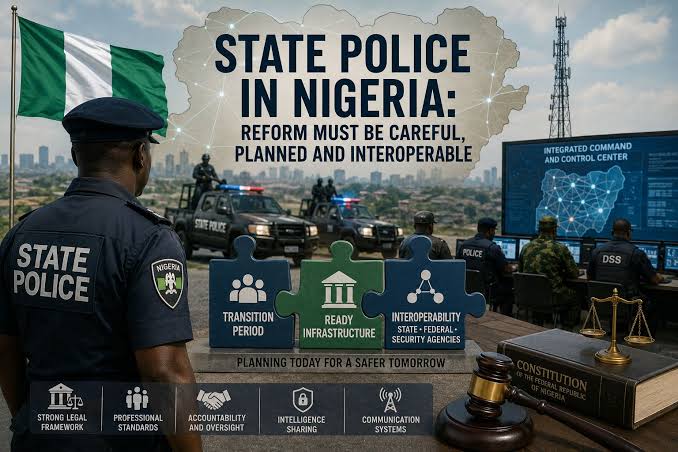
The debate between proponents and opponents of State Police need not bend in an impasse. The evidence from comparative federalism suggests that state-level policing can succeed, but only under specific institutional conditions. Nigeria must be deliberate about building those conditions if the reform is to serve its stated purpose.
The following framework of safeguards deserves serious legislative and constitutional attention:
1. Independent State Police Service Commissions:
Appointment, promotion, discipline, and dismissal of state police officers should be vested in independent commissions insulated from direct gubernatorial control. Governors must not have unilateral power to hire or fire officers whose primary loyalty should be to the law, not to their political patron.
2. Federal Constitutional Oversight:
A federal oversight body, with representation from civil society, the judiciary, and the legislature, should have the authority to intervene when state police forces are deployed for manifestly unconstitutional purposes. The power to suspend or take over a state force that systematically violates citizens’ rights must be clearly established in law.
3. Uniform National Training Standards:
All state police officers must be trained under standards set and supervised by the Nigeria Police Council and the Federal Government. This will ensure a baseline of professionalism, human rights compliance, and operational competence that cannot be diluted by individual states.
4. Fiscal Equalisation Mechanisms:
A dedicated federal fund should be established to supplement the budgets of states unable to independently sustain adequate police operations. Security must not become a privilege of the prosperous.
5. Constitutional Protections for Political and Minority Rights:
Explicit constitutional provisions must prohibit the deployment of state police forces for electoral interference, suppression of political opposition, or persecution of ethnic or religious minorities. Violating these provisions should constitute a criminal offence with serious personal consequences for the authorising officer.
6. Robust Civil Society and Media Freedom:
Without a vibrant press and an active civil society willing and able to expose abuse, any accountability framework remains theoretical. Strengthening press freedom and civil society organisations must be understood as integral to the success of police reform.
The Deeper Question: What Kind of Nigeria Do We Want?
At its core, the State Police debate is not merely a technical question about security architecture. It is a referendum on Nigeria’s vision of itself as a federal state. For decades, the nation has maintained the outward form of federalism while practicing something closer to unitarism in its institutional arrangements. Power has remained concentrated at the centre even as the centre has repeatedly demonstrated its inability to govern effectively across the vast diversity of the Nigerian space.
Former President Olusegun Obasanjo once observed that a nation cannot achieve peace without security, and security cannot be sustained without justice. That insight cuts in two directions: it affirms the urgency of security reform while reminding us that security divorced from justice is merely organised coercion. Any State Police arrangement that strengthens coercive capacity without building accountability and justice will not bring Nigeria closer to peace, it will merely redistribute the sources of oppression.
The philosopher John Locke, whose ideas undergird much of modern democratic governance, argued that the end of law is not to abolish or restrain, but to preserve and enlarge freedom. State Police that is properly designed and robustly accountable can preserve and enlarge freedom for millions of Nigerians currently living in fear. State Police that is poorly designed and politically captured will merely add another instrument of terror to the existing catalogue.
The choice belongs to Nigeria’s citizens and their elected representatives.
Conclusion: Reform With Eyes Wide Open
The proposal for State Police represents one of the most consequential governance decisions of the Tinubu era, and potentially of Nigeria’s post-independence history. The arguments for it are substantial and rooted in the lived experience of communities that feel abandoned by a distant, overstretched federal policing apparatus. The arguments against it are equally weighty, rooted in the equally lived experience of abuse by security structures under political control.
This is not a debate where one side is obviously right and the other obviously wrong. It is a debate where the right outcome depends entirely on the quality of the institutional design, the seriousness of constitutional safeguards, and the political will to hold power accountable.
Nigeria has too often enacted reforms that were sound in conception and catastrophic in implementation, because the hard work of building institutions was neglected in the enthusiasm for legislative milestones. State Police must not follow that pattern. The legislation enabling it must be as carefully constructed as it is boldly conceived.
The security of the Nigerian people, all of them, in every corner of this complex and magnificent nation, is too precious a trust to be left to chance, to political goodwill, or to the integrity of any single leader. It must be secured in law, in institutions, and in the unyielding vigilance of a citizenry that refuses to surrender its rights.
Nigeria stands at a defining moment. The decisions made today about how to police this nation will shape the safety, freedom, and dignity of Nigerians for generations to come. Let those decisions be made wisely, boldly, and above all, accountably.
“The safety of the people shall be the highest law.”
— Marcus Tullius Cicero
