


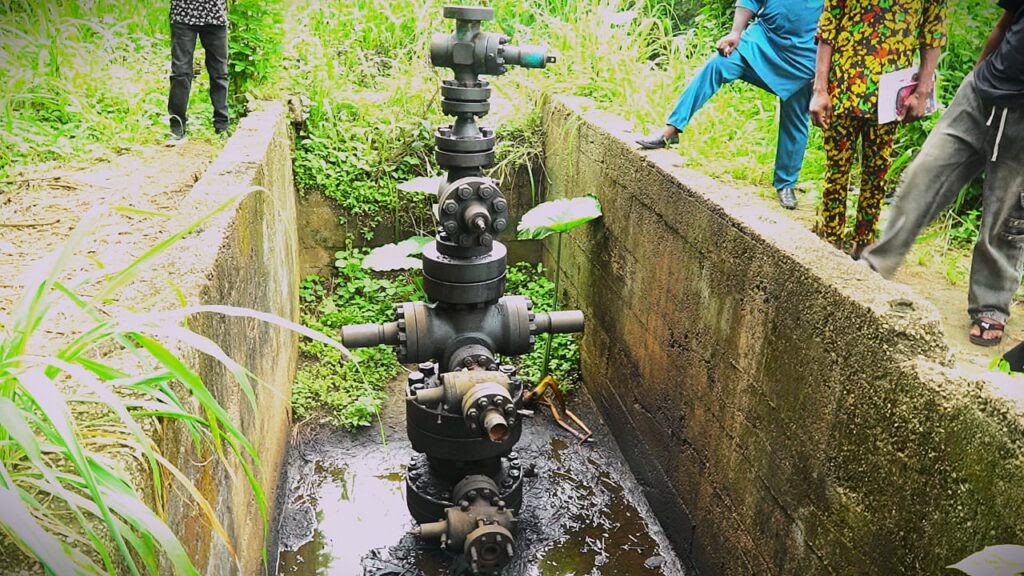
Nearly seven decades after Shell drilled and abandoned oil wells in parts of Akwa Ibom State, communities in Ikono and Ibiono Ibom Local Government Areas are demanding that the company and government authorities account for the environmental damage and livelihoods they say have been left behind.
The communities say the wells may have ceased to have commercial value for the oil company after being declared unviable, but their environmental consequences have remained a daily reality for residents.
They reported declining agricultural yields, dying economic trees, disappearing fish and snails, polluted streams, deteriorating property, insecurity and loss of livelihoods linked to the abandoned oil infrastructure.
The demands came at a capacity-sharing dialogue organised by the Health of Mother Earth Foundation (HOMEF) under its Fossil Politics project at Ikot Enua on September 9, where traditional rulers, women, youths and other residents presented accounts of the impact of decades-old petroleum activities on their communities.
At the centre of the dispute is a question with implications beyond Akwa Ibom: when an oil company abandons a commercially unviable well, who bears responsibility for the environmental consequences left behind?
For HOMEF, abandoning the wells cannot mean abandoning responsibility.
The organisation said the affected territories should not remain burdened with hazardous infrastructure and degraded ecosystems simply because petroleum extraction is no longer commercially attractive.
HOMEF Executive Director, Dr Nnimmo Bassey, said affected communities must be central to decisions concerning abandoned wells and the future of their territories.
“Communities must speak for themselves. They live here and understand the issues better than outsiders.”
Bassey drew attention to continuing petroleum-related hazards elsewhere in the Niger Delta, including gas bubbling and fire incidents reported in Bille, Rivers State, as evidence of the risks communities can continue to face around oil infrastructure.
The Executive Director of Peace Point Development Foundation, Mr Umo Isua Ikoh, also criticised what he described as an unequal distribution of the benefits and burdens of oil extraction.
“Oil can be a blessing to Abuja but never to the host communities,”
he said, citing Ikot Ebidang in Onna Local Government Area, where he said an ongoing flare had displaced members of the host community.
‘We can’t plant in our farms anymore’
The strongest evidence presented at the dialogue came from residents who described changes in their environment and livelihoods over the years.
Chief Felix Vincent Udoh of Ikot Enua reported declining agricultural productivity and the death of oil palm seedlings, while cocoyam, snails and fish species that were once part of the community’s ecological and economic life were said to have disappeared.
He also raised concerns about insecurity around abandoned oil infrastructure and declining soil fertility.
According to Udoh, corrugated roofing sheets in the community now rust and deteriorate unusually quickly, with some reportedly lasting less than five years.
He further alleged that Ikot Enua won its case against Shell at the High Court and Court of Appeal in 2013 but said the company had yet to comply with the judgment.
In Adara Abom, Mr Moses Udo said oil pollution had severely affected fishing, depriving residents of an important source of food and income.
Barrister Trust Udoh of Uyo Afaha Nkan gave another account of the impact, saying oil spills had contaminated water sources and affected farming.
“We can’t plant in our farms anymore,”
he said, while calling for the removal of the oil installation.
Residents of Ikot Idaha, Edem Udua and Ediene Atai similarly reported destruction of economic trees and declining agricultural yields.
In Ntan Mbat, residents said crops such as okra and cocoyam no longer yielded properly and sometimes died prematurely. They also complained about an abandoned road project reportedly initiated by the Niger Delta Development Commission.
Nkara Obio residents reported polluted streams and declining crop yields.
The individual testimonies, HOMEF said, pointed to a broader pattern across the affected communities: declining production of yam, cassava, cocoyam, okra and other crops; destruction of economic trees; disappearance of fish, snails and other species; polluted water sources; insecurity and inadequate infrastructure.
Seven decades of an unfinished oil story
The grievances revive a long-running problem in the Niger Delta, where oil extraction has generated substantial national revenue while producing persistent disputes over pollution, compensation, land degradation and community rights.
The region became the centre of Nigeria’s petroleum economy following the discovery and commercial exploitation of crude oil in the Niger Delta. Over subsequent decades, extensive networks of oil wells, pipelines, flow stations and other infrastructure were established across communities.
But when wells become commercially unattractive, the physical infrastructure and environmental liabilities do not necessarily disappear with the end of production.
For communities such as those in Ikono and Ibiono Ibom, the issue is therefore no longer simply whether oil remains beneath their land. It is whether decades-old installations can be safely decommissioned and whether land and water affected by petroleum activities can be restored.
HOMEF said the answer should not be another cycle of extraction.
The organisation rejected the argument that renewed exploitation of abandoned wells should automatically be treated as the solution to the communities’ economic difficulties, insisting that restoration and sustainable livelihoods must take priority.
Focus turns to Ikono 1
HOMEF specifically called on the Federal Government, Shell, regulatory agencies and the Akwa Ibom State Government to address outstanding claims relating to the abandoned Ikono 1 oil well.
It cited the 2013 Court of Appeal decision in Eteidung Raymond F. Obot & Ors. v. Shell Petroleum Development Company Nigeria Limited (CA/C/70/2011), which allowed environmental claims from 2006 onward to proceed.
The organisation called for proper assessment of abandoned wells and hazardous infrastructure, permanent decommissioning where extraction has ceased, removal of dangerous installations and comprehensive environmental cleanup.
It also demanded investigation of reported health concerns, long-term environmental monitoring and compensation for losses involving farmland, crops, economic trees, fishing grounds, property and livelihoods.
The communities want improved security, employment opportunities and skills development, alongside support for sustainable agriculture, fishing and other non-extractive livelihoods.
Beyond the abandoned wells
The controversy raises a larger issue about the legacy of extraction in Nigeria’s oil-producing communities.
For decades, oil has been presented as a major engine of national development. Yet residents living closest to extraction sites often measure its legacy differently — through the condition of their farms, streams, fishing grounds, homes and sources of income.
In Ikono and Ibiono Ibom, residents are now demanding that the end of commercial interest in an oil well should not mark the end of corporate and governmental responsibility.
HOMEF said restoration must go beyond simply closing a well or removing equipment.
It wants polluted land and water restored, damaged ecosystems rehabilitated, affected livelihoods addressed and communities involved in decisions about their territories.
The organisation also warned against turning environmental restoration into a pretext for renewed extraction, arguing that communities should be supported to build sustainable livelihoods that do not depend on continued degradation of their ecological resources.
The message from the communities is therefore not simply about abandoned oil wells.
It is about what happens after the oil is gone — who pays for the damage, who restores the land and whether communities that have carried the environmental costs of extraction for generations can finally reclaim their farms, waters and livelihoods.
The wells may have been abandoned decades ago. The communities insist that responsibility must not be abandoned with them.
