


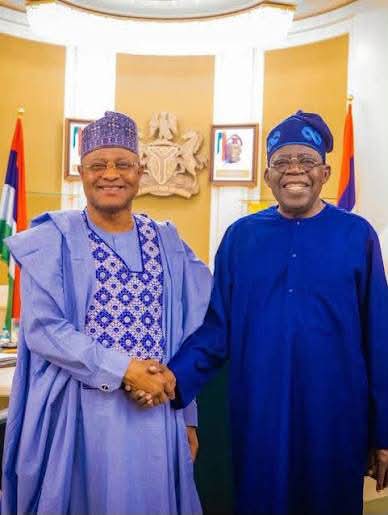
Sometime in late July 2026, Governor Uba Sani summoned a meeting of APC aspirants who did not win their primaries in Kaduna State.
I remember walking into that room and immediately sensing the tension.
There were close to a hundred people from virtually every part of Kaduna State, by my estimate. Some had sought tickets for the State House of Assembly, others for the House of Representatives or Senate.
There was anger. There was disappointment. People were unhappy.
I wondered what exactly the Governor hoped to achieve. How do you bring together politicians who have invested their time, money, reputations and ambitions in contests they did not win—and persuade them that they still have a place in the same political family?
Then Uba Sani walked in.
What followed was, in my view, a masterclass in practical politics.
He did not lecture anyone about loyalty. Instead, he told his own story: the elections he had lost, the disappointments he had endured and the long journey that eventually brought him to Government House.
Within about fifteen minutes, the atmosphere appeared to change.
He spoke with the credibility of someone who had travelled that road himself. His message was simple: losing an election hurts, but today’s setback does not determine tomorrow’s opportunity.
Then he opened the floor and allowed people to speak honestly.
I remember sitting beside one aspirant who had arrived visibly angry. I nudged him and asked:
“Sir, aren’t you going to say anything?”
He replied:
“What is there to say? After hearing what this man has said, what is there to say? Let’s just see how we can work together to make this party great.”
Indeed, one of the Governor’s most vocal critics did not only renew his commitment to the party and the government—he went further to announce a very sizeable donation to the Uba Sani/Tinubu campaign.
That stayed with me.
Two words increasingly define Uba Sani’s political philosophy for me: inclusion and accommodation.
But promises in politics are easy. Keeping them is another matter.
The Governor made commitments that day concerning the aspirants and their continued place within the political family. I was sceptical that everyone could possibly be accommodated.
Afterwards, I watched those commitments begin to translate into action. Refunds were made, support was provided and, over time, several former aspirants were brought into government or otherwise remained connected to the wider political family.
In my experience, he kept his word.
And that brings me to something much bigger.
A GOVERNOR OF ALL KADUNA
My first substantial conversation with Governor Uba Sani was in June 2024.
He told me, in effect:
“I am not the Governor of Zone 1, Zone 2 or Zone 3. I am the Governor of Kaduna State. If development does not reach every part of this state, then I have failed.”
As a son of Southern Kaduna, those words mattered to me.
I had serious disagreements with the previous Kaduna State administration and suffered consequences because of them. So I did not approach another APC government without caution.
But political maturity requires us to judge governments not simply by party labels, but by what they actually do.
And there is evidence of substantial activity across Kaduna today.
The state has undertaken around 140 road projects covering more than 1,300 kilometres across all 23 local government areas, including communities that had gone decades without meaningful road infrastructure.
At the federal level, Kaduna is also benefiting from major transport investments: the Abuja–Kaduna–Zaria–Kano highway, the Kaduna–Birnin Gwari road, the Kaduna–Kano railway and the proposed Kaduna metropolitan light rail.
These projects are at different stages of implementation, but taken together with Kaduna’s CNG buses and the existing Abuja–Kaduna railway, they point towards something potentially transformative.
They could make it increasingly practical to live in Kaduna and work in Abuja.
That opens the possibility of a genuine Kaduna–Abuja economic corridor—attracting housing, businesses, investment and jobs while allowing Kaduna to benefit from Abuja’s economic gravity.
Education tells an equally important story.
Kaduna’s out-of-school population has fallen from approximately 550,000 to about 187,720, according to state figures. A major part of the approach has been household mapping across all 23 local governments to identify the actual children and communities requiring intervention.
Significantly, in July 2026, the Federal Government adopted Kaduna’s household-mapping approach as a framework for tackling out-of-school children nationally.
That tells us something important: an approach being implemented in Kaduna is now influencing how Nigeria confronts one of its most difficult educational challenges.
Healthcare has also seen investment in primary healthcare centres, hospitals, health workers and insurance coverage.
And then there is security.
We must be honest: serious challenges remain. But what I find significant is that Governor Uba Sani is not resting on federal might alone.
Kaduna has just graduated more than 1,000 trained Armed Forest Guards to complement conventional security agencies, particularly in vulnerable rural and forest communities, and the Governor has sought to expand that capacity with another 1,000 personnel.
But security is not only about guns, soldiers and forest guards.
The state also recently graduated 4,050 young people from its vocational training programme, equipping them with practical skills intended to improve their prospects for employment and entrepreneurship.
For me, these things are connected.
A serious security strategy must confront the criminals in our forests, but it must also confront unemployment, poverty and the absence of opportunity that can make young people vulnerable to crime and recruitment into criminal networks.
So the emerging strategy is broader: stronger federal-state security cooperation, local security capacity through the Forest Guards, and investment in skills, jobs and livelihoods.
Security is ultimately not just about defeating criminals. It is also about creating communities where people can live safely, work productively and see a future for themselves.
Progress should never be confused with completion.
But neither should the work still left to do become an excuse to deny progress that is visible and measurable.
WHY THIS MATTERS FOR 2027
This is where President Bola Ahmed Tinubu comes into the conversation.
His administration has made consequential decisions affecting Kaduna and Southern Kaduna.
The appointment of General Christopher Musa, a son of Southern Kaduna, first as Chief of Defence Staff and subsequently as Minister of Defence is politically and symbolically significant.
But our judgement cannot rest on appointments alone.
We should ask harder questions:
Are roads being built? Are schools improving? Is healthcare receiving investment? Is security cooperation producing results? Is Kaduna getting a fair hearing in Abuja?
My own assessment is that the relationship between the Kaduna State Government and the Federal Government is producing visible areas of cooperation and investment.
And this is why the APC feels different to me in Kaduna today.
I know what it means to oppose a government.
I have done it publicly and at considerable personal cost.
I suffered under an APC government in Kaduna. I had serious disagreements with the previous administration and spent years away from home partly because of that confrontation.
So if anyone has reason to approach another APC government cautiously, I do.
But there is something intellectually dishonest about demanding better government and then refusing to acknowledge progress when you see it simply because the people delivering it belong to a political party you once opposed.
We must be prepared to change our conclusions when the evidence changes.
That does not mean accepting every government claim uncritically. It means being willing to recognise results when they are there.
The APC in Kaduna today must be judged by the leadership governing Kaduna today—not simply by our memories of the leadership that preceded it.
From my observation, Uba Sani has chosen reconciliation over division and inclusion over exclusion.
And the relationship between his administration and President Tinubu’s Federal Government is producing tangible benefits for Kaduna.
I saw Uba Sani’s philosophy in that room of disappointed aspirants.
I watched anger turn into conversation.
And I subsequently watched commitments become actions.
That is why, as 2027 approaches, perhaps the strongest political argument available to him is not a campaign slogan.
It is much simpler:
In my experience, he kept his word.
And perhaps that is how we should approach politics generally.
Not simply APC or PDP. North or South. Christian or Muslim. Friend or enemy.
Ask instead:
Who is delivering? Who is listening? Who is investing in our communities? Who is creating the conditions for peace and prosperity? And who, when he gives his word, actually keeps it?
I have been a critic when criticism was necessary.
I am equally prepared to acknowledge progress when progress is evident.
That is not inconsistency.
That is the responsibility of citizenship.
