


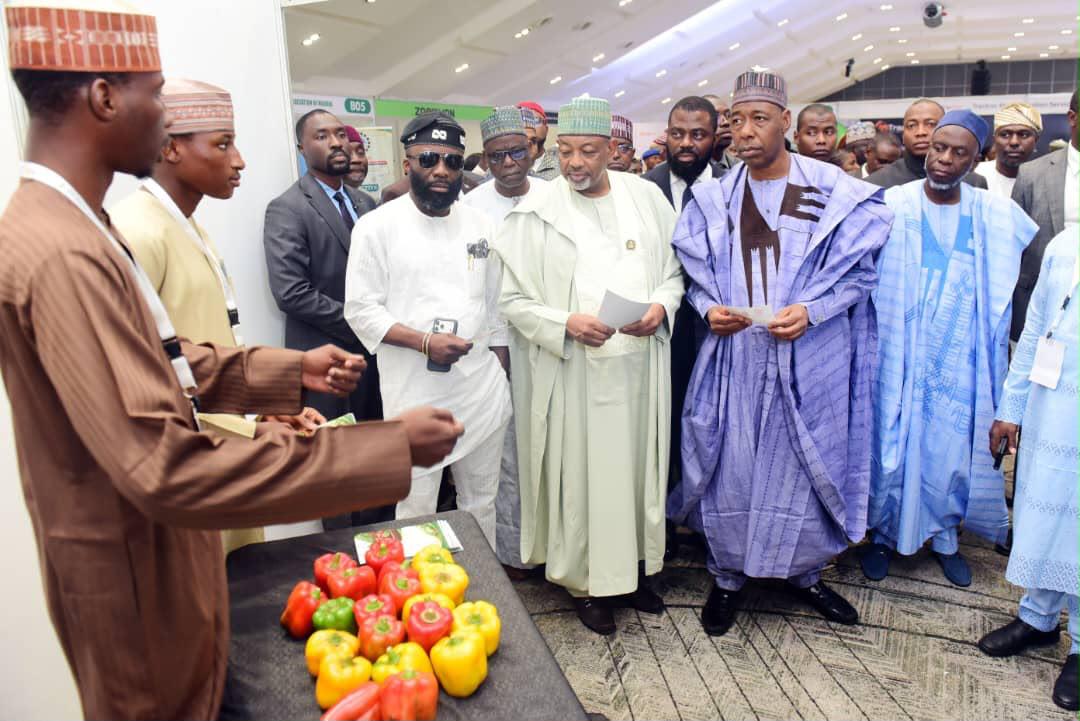
Borno State Governor, Prof. Babagana Zulum, has called for a fundamental overhaul of Nigeria’s agricultural mechanisation policy, urging the country to move beyond the purchase and ownership of tractors to a modern, service-driven system that gives farmers timely access to machinery, technology and finance.
Zulum made the call on Wednesday, 12 August, 2026 in Abuja at a High-Level National Policy Dialogue on Agricultural Mechanisation, organised by the Federal Ministry of Agriculture and Food Security.
The Governor said Nigeria could not achieve food security, create sustainable rural jobs or compete in global agricultural markets by merely increasing the number of tractors in the country.
He argued that mechanisation must be treated as an integrated agricultural service, enabling farmers to access land preparation, precision farming, irrigation and other modern technologies when they need them, rather than leaving expensive equipment idle or inaccessible.
Zulum identified low productivity, inadequate technology, limited investment and weak agricultural value chains as some of the major obstacles holding back Nigeria’s agricultural transformation.
He said the country needed to adopt a new agricultural model built around productivity, digital technology, sustainability and private-sector investment.
The Governor outlined a four-pronged strategy for transforming agricultural mechanisation: mechanising agriculture to raise productivity and reduce drudgery; digitalising farming to improve precision, intelligence and efficiency; regenerating agricultural resources to guarantee long-term sustainability; and investing in infrastructure, technology and enterprises capable of driving agricultural transformation.
According to him, Borno’s own agricultural transformation programme is being pursued as a critical component of the state’s efforts to rebuild livelihoods and restore communities devastated by insecurity and displacement.
Zulum stressed that agricultural investment must therefore go beyond production to encompass irrigation, storage, processing and value addition, particularly in areas where agriculture remains the main source of livelihood.
He called for stronger private-sector participation and innovative financing mechanisms to support the local manufacture and assembly of agricultural machinery, as well as investments in irrigation systems, renewable energy, storage facilities and agro-processing.
The Governor also emphasised the need to expand opportunities for young people and women to participate in commercially viable agricultural enterprises.
“We must not simply recreate the agriculture of yesterday; we must build the agriculture of tomorrow,” Zulum said, stressing that Nigeria’s future agricultural system must be modern, smart, climate-resilient, productive and inclusive.
He said the ultimate objective should be to create an agricultural economy capable of feeding Nigeria’s growing population, competing in international markets, generating jobs and delivering sustainable prosperity to rural communities.
The Governor was accompanied to the policy dialogue by a member of the House of Representatives, Engr. Bukar Talba; Borno State Commissioner for Local Government and Emirates Affairs, Sugun Mai Mele; Chief Executive Officer/Managing Director of the Borno Investment Company, Mohammed Bukar Umar; and Permanent Secretary, Government House, Mustapha Ali Busiguma.
