


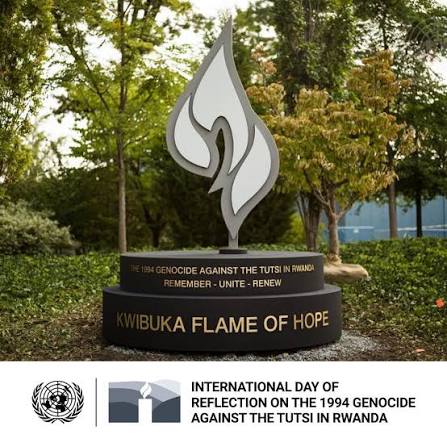
Rwanda has issued a powerful warning to the world as it marks the 32nd anniversary of the 1994 Genocide against the Tutsi, cautioning that the dangerous ideologies that fueled the mass killings have not disappeared—but are mutating in more sophisticated and far-reaching ways.
Speaking at a solemn commemoration in Abuja, the Rwandan High Commissioner to Nigeria, Moses Rugema, urged the global community to move beyond ceremonial remembrance and confront the persistent and evolving threat of genocide ideology, particularly in an era shaped by digital influence and artificial intelligence.
The event, held under the theme “Remember. Unite. Renew.”, marked Kwibuka 32, an annual period of reflection on one of the darkest chapters in modern history.
He said: “Remembrance must carry responsibility. It is not enough to honour the dead—we must actively resist the forces that made such atrocities possible.”
He recalled the scale of the Genocide against the Tutsi, in which more than one million people were systematically killed within 100 days in 1994. The envoy stressed that the genocide was not a spontaneous eruption of violence, but a calculated campaign driven by propaganda, division and state-backed extremism.
Drawing a direct line between the past and present, Rugema warned that similar patterns are re-emerging globally, now amplified by technology.
“The tools may have changed, but the intent has not. Today, hate can spread faster, deeper and more dangerously through digital platforms,” he said, noting that misinformation, denial and distortion are increasingly weaponised to rewrite history and inflame divisions.
He called for stronger international legal frameworks, improved civic education and stricter accountability measures to counter what he described as a “resilient and adaptive threat.”
Rugema also revisited the failure of the international community during the 1994 crisis, stating that early warning signs were ignored and the scale of the violence was initially downplayed. At the United Nations Security Council, only a handful of voices—including Nigeria’s former envoy, Ibrahim Gambari—pressed for recognition of the atrocities as genocide.
The killings were eventually halted by forces of the Rwandan Patriotic Front, led by current President Paul Kagame, ushering in a new chapter focused on national rebuilding.
Highlighting Rwanda’s recovery, Rugema pointed to deliberate policies aimed at unity and reconciliation, including the dismantling of ethnic classifications and the use of community-based justice systems such as gacaca courts, which enabled millions of cases to be heard while fostering dialogue and healing.
Yet, he warned that the work is far from over.
“Genocide ideology is not confined to history—it is a present danger,” he said, citing ongoing instability in parts of Africa’s Great Lakes region and the growing normalization of hate speech globally.
Also addressing the gathering, the UN Resident Humanitarian Coordinator in
Nigeria, Mohamed Fall described the commemoration as a call to action for the international community to prevent future atrocities.
Represented by the UN Women Coordinator to Nigeria and ECOWAS, Beatrice Eyong, Fall emphasised that the genocide was enabled by sustained propaganda and exclusionary policies.
“Mass atrocities do not begin with weapons—they begin with words,” Fall said. “And today, those words travel faster than ever.”
He warned that the unchecked spread of hate speech and incitement in the digital space poses a growing global risk, urging governments to strengthen legal protections, uphold international law and fully implement the Genocide Convention.
Both speakers stressed that remembrance must translate into concrete action, insisting that the phrase “Never Again” risks becoming hollow if not backed by political will and societal vigilance.
As the world reflects on Kwibuka 32, Rwanda’s message was unmistakable: the cost of indifference has already been written in blood—and failing to act now could allow history to repeat itself.
