


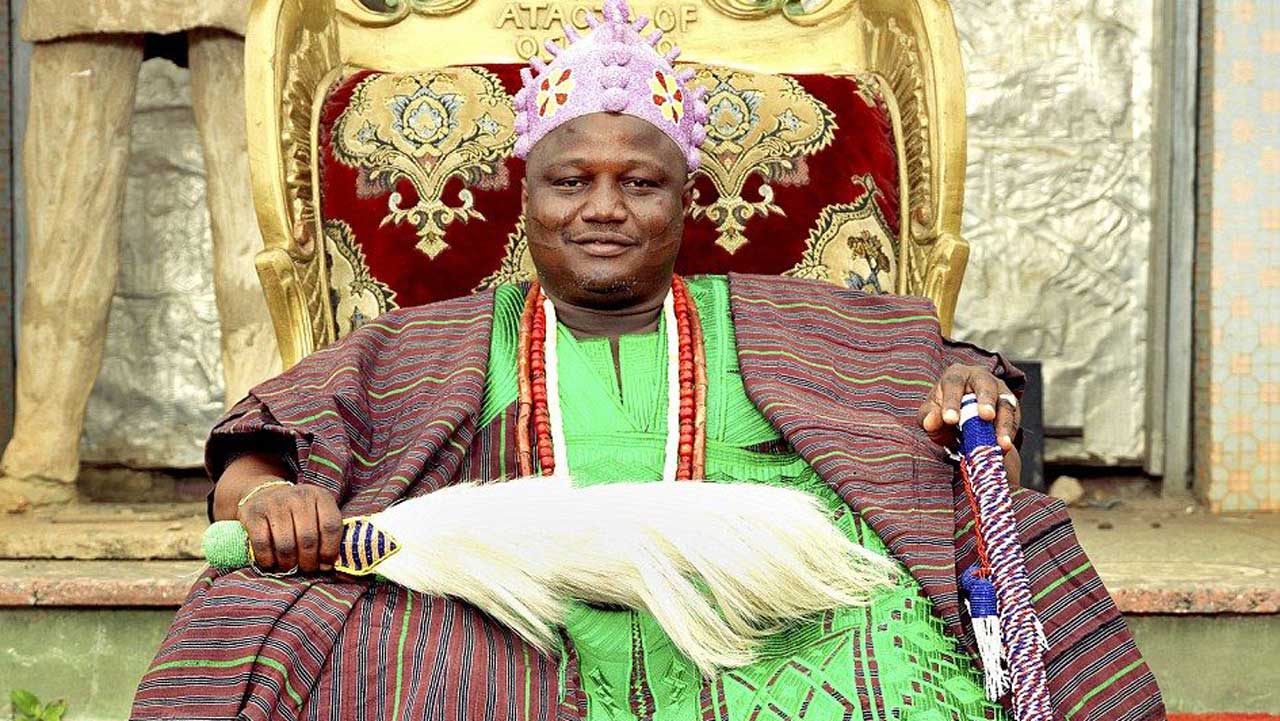
By Tunde Odesola
(Published in the PUNCH, on Friday, July 24, 2026)
It’s midmorning in Àtàọ́ja’s palace. The sun beamed a friendly smile, quite different from the furious furnace it was preparing for the afternoon. As gently as the breeze caressed the trees in the palace, two pigeons landed on silent feet in the courtyard. They were on a joint mission. To scavenge. Looking right and left, up and down, beaks at work, wings at the ready, the bouncy birds pecked food in the palace soil. For the male and female pigeons, danger lies not in flying; it lies in walking. Sycophancy walks naked on the palace grounds.
Even the king’s kààakí was caught unawares. It couldn’t herald what was about to happen because everything occurred at a dizzying speed. The Àtàọ́ja, Oba Jimoh Olanipekun, ran out from the inner recess of the palace, his agbada òfì billowing in the Osogbo wind; kira-kita, kira-kita, the king bolted like Usain Bolt. Where is the king running to?
In his breakneck flight, Àtàọ́ja Osogbo forgot to wear his neck beads! I-m-a-g-i-n-e! But he luckily remembered to wear his cap. I suspect it was ancestral forefathers known as ‘àwọn alálẹ̀’ who reminded him to wear his shoes. Otherwise, the king might have appeared out of sorts at the state government event he was fleeing to.
Thankfully, when Àtàọ́ja Olanipekun reached his destination, he still had some breath in his lungs. He sat down, resplendent in white and blue agbada, clenched the microphone and confessed in Yoruba, “Ẹ̀ ri pé ń ò kólẹ̀kẹ̀ ọ́rùn? Mo sáré dé hin ni. Tí a bà á wá, wọ́n á ní, ‘Háà, kò mọ̀ le bọ́ta mọ́!’ Gbogbo ohun tí wọ́n ń sọ là ń gbọ́.”
I’ll translate the king’s speech in English: “Can’t you see that I am not wearing my royal beads? (It is because) I ran to this event. Because if I did not come, they would say, ‘Ha! He cannot come out again!’ We hear everything that they (opposition) are saying. I will not stop eulogising Adeleke Jackson Nurudeen for his excellent performance in Osun State.”
Unfortunately, Olanipekun thinks that by singing himself hoarse on the praise of ebullient Governor Ademola Adeleke, he is giving the re-election bid of the Asiwaju of Ede a boost. No, he is not. If he was, the apex socio-cultural association of Osogbo sons and daughters, the Osogbo Progressive Union, would not openly criticise him for publicly canvassing support for Adeleke and attacking the opposition on many occasions.
The penis of the bird does not dangle outside; it is tucked inside the bird, says a Yoruba proverb. This proverb preaches decorum. If the king had been decorous like other Osun kings, who, though, have their favourites among the governorship candidates, but who have kept their support within the ambit of decency, the OPU wouldn’t have embarrassed him with a public disclaimer.
The Timi of Ede, Oba Muniru Adesola Lawal, had been an exemplar in his support for Adeleke, who hails from his domain. The Timi had been regal: zero aggression, zero hate words, zero campaign against other parties. Oba Timi has shown emotional intelligence while fully supporting Adeleke, his son. That is how to be a father to all subjects. Of course, if Timi was blindfolded at the polling booth on election day, his royal thumb would still locate Accord Party on the ballot, whereas some carricachop from another land is claiming to know Ọ̀ṣọ́ more than Ọ̀ṣọ́’s mother.
It’s undignifying for the elderly to run helter-skelter, says a Yoruba proverb distilled in these words, “Gbàmí, gbàmí ò ye àgbà.” Another proverb that cautions against kùrùkẹrẹ movement says, “Ẹní wọ bàtà ẹsẹ̀ òsì méjì, ó níbití ó ń lọ.”
The importance of royal objects such as crown, beads and staff is interrogated in the seminal work, “Yoruba: Nine Centuries of African Art and Thought,” written by Henry J. Drewal et al, and published by The Centre for African Art, New York, in 1989. Similarly, the royal totems – crown, beads and staff – are also a subject of scholarship in Rowland Abiodun’s “Yoruba Art and Language: Seeking the African in African Art,” published by Cambridge University Press in 2014.
Drewal and Abiodun aver that in Yoruba thought, the crown, beads and staff are sacred totems that signify divine authority, spiritual protection, leadership, ancestral continuity, and the king’s covenant with the people and the gods.
In both books, the crown is regarded as a sacred emblem containing the spiritual essence that connects the present with the past. Royal beads signify dignity and prestige, abundance and prosperity, and spiritual energy. The staff is an instrument of authority, justice, fairness, and protection.
Joro-jara-joro is an onomatopoeic word that means helter-skelter. Onomatopoeic words are words that sound like their meanings. Examples: buzz, hiss, slap, sleep, twinkle, jab, splash, tear, bang, etc. Joro-jara-joro was amplified by Afrobeat creator Fela Anikulapo-Kuti in his 1976 song, “Zombie”, which mocks Nigerian soldiers’ blind allegiance to dictatorship.
In “Zombie”, Fela caricatures Nigerian soldiers as unthinking brutes whose sole skill is to chaotically rove joro-jara-joro against the masses, like zombies on the mission to “go and kill, go and quench, go and die”. Fela sings, “Zombie way na one way; joro-jara-joro/No break no jam, no sense; Na joro-jara-joro….”
There would have been no reason to write this article because I had made my intention clear enough in an earlier article entitled, “Governor Adeleke and a tale of three Àtàọ́jas,” published in The PUNCH on Friday, July 17, 2026. My preoccupation in the article was to call the attention of the monarch to some of his unkingly utterances. My intention wasn’t political. But an insinuation, especially from some irritating ‘e-rats’ and ‘data boys’, who attempted to paint my intervention in political colours, made this sequel inevitable.
In line with their zombie mentality, a particular ‘e-rat’ along with his fellow ‘data boys’ accused me of meddlesomeness and maintained that it lies within the rights of the Àtàọ́ja to express support for any candidate of his choice.
Clearly, the accusation of meddlesomeness was borne out of dripping ignorance. If not, an enlightened mind would see that the actions of the Àtàọ́ja diminish his traditional stool that represents the Yoruba worldview of unity, morality, justice, fairness and equity. The allegation that the Àtàọ́ja had the right to support any candidate of his choice is valid to the extent that such a right must not violate the principles of fair play, rule of law and decency.
By openly calling the opposition names in a viral video, did the Àtàọ́ja adhere to the principles of fairness and tolerance? By his vitriolic speeches, was he not stoking the embers of strife? If I could be provided with the evidence of one Osun traditional ruler who had been as politically intolerant as the Àtàọ́ja, against the ruling party, I shall tender an apology in my next article.
In one of the bad-taste videos, the Àtàọ́ja arrogantly disclosed how he rejected wise counsel by a concerned citizen, who told him the danger in his public support for Adeleke over other candidates. His words, “One of my people asked me why I am so audacious to the extent of overly supporting one candidate (Adeleke) over others; what if he doesn’t win?”
The king answered the worried citizen. Àtàọ́ja opened his mouth and played god, declaring with finality: “He will win.” Olanipekun’s divisive posture is most unbecoming of an ọba, whose palace should be an abode to seek conflict resolution by his subjects, including politicians. Àtàọ́ja should not be the epicentre of conflict.
In the recent past, I have ventilated my views on the actions of the Ooni of Ife, Oba of Lagos, Apetu of Ipetumodu, Alapomu of Apomu, Oluwo of Iwo, and Emir of Ilorin, among other traditional rulers. I strongly believe that it behoves the citizen to hold traditional rulers to the highest standards because the traditional institution embodies the ethos and pathos of a race.
For ‘e-rats’ and ‘data boys’, whose stock-in-trade is abuse, there is a lesson in the conduct of a member of the House of Representatives, Bamidele Salam. Salam is my friend of over 20 years. Though we have had moments of sharp disagreement, emotions never boiled over to name-calling.
One day, BS, that’s Salam’s nickname, saw my Facebook post on Governor Adeleke. In the post, I advised the governor against excessive dancing and to shear off some personalities who were following him about like houseflies following the wound on a dog’s ears. In the Facebook post about three years ago, I cautioned that the image of the governor dancing to the faintest of drumbeats amid a retinue of hangers-on was not good.
As soon as BS saw the post, he reached out to me on the phone and said, “Ọ̀rẹ́, ọ̀rọ̀ ò rí bẹ́yẹn o. Your post does not reflect the great work Adeleke is doing in Osun…” I smiled from the other end of the phone because Bamidele was pushing Adeleke’s narrative while ignoring the kernel of my Facebook post. When I insisted on the need for the governor to do better in regard to dancing, Bamidele said every man was a work in progress, including me. Bamidele’s example is how to engage intelligently; a lesson government and opposition ‘e-rats’ and ‘data boys’ should learn.
The demarcation between a ruling party and an opposition party is nebulous. Practically speaking, ideological philosophies among Nigeria’s political parties are nonexistent. This is why Àtàọ́ja should be careful in his untraditional support for Adeleke. The Adeleke he sees in the Accord Party today could be in the All Progressives Congress tomorrow. Olanipekun should not burn the bridge of friendship today because he might need to use the bridge tomorrow.
This is the lesson Àtàọ́ja Olanipekun should see in his recent visit to President Bola Tinubu in Abuja. When politicians do their thing, a respectable ọba should maintain a dignified distance. He should not be in the fray.
Are you shocked that Kabiyesi Olanipekun was in Aso Rock a few days ago? Yes, he was. As a guest of President Bola Tinubu. This is the story of how the monarch used one stone to kill two birds. Àtàọ́ja’s daughter was graduating from the Law School in Abuja. An influential Osun State indigene, worried by the king’s intolerant posture against the Osun All Progressives Congress, had arranged for the king to meet with the President. It took some time for the king to meet the President.
During their meeting, the President expressed worry over Àtàọ́ja’s political remarks against the APC in Osun, urging him to allow for a level playing field. I gathered that Àtàọ́ja told the President that he was sold on the Adeleke ticket. Personally, I do not fault Àtàọ́ja’s position – supporting a candidate of his choice; it’s his brickbat approach that is reproachable.
If Tinubu could open his doors to Olanipekun and sit down to dialogue with him, who says there cannot be a dialogue between Tinubu and Adeleke? And if a dialogue occurs between the two and an agreement is struck, would the king not feel uneasy relating with his ‘enemies’ in the APC? The king should always spare a thought for the flip side of things. That is what the wise do.
“Àgbàlagbà kìí ṣe lángbá, lángbá,” is a cautionary proverb for reckless elders. The pit of animosity must not be dug too deep because the digger might fall into it. A word is enough for the wise.
Kabiyesi Àtàọ́ja, kara o le o.
///
Email: tundeodes2003@yahoo.com
Facebook: @Tunde Odesola
X: @Tunde_Odesola
