


The Philippines has challenged Nigeria to move beyond policy declarations on gender equality and strengthen its laws, institutions and accountability mechanisms to ensure that women’s inclusion becomes an enforceable reality across government.
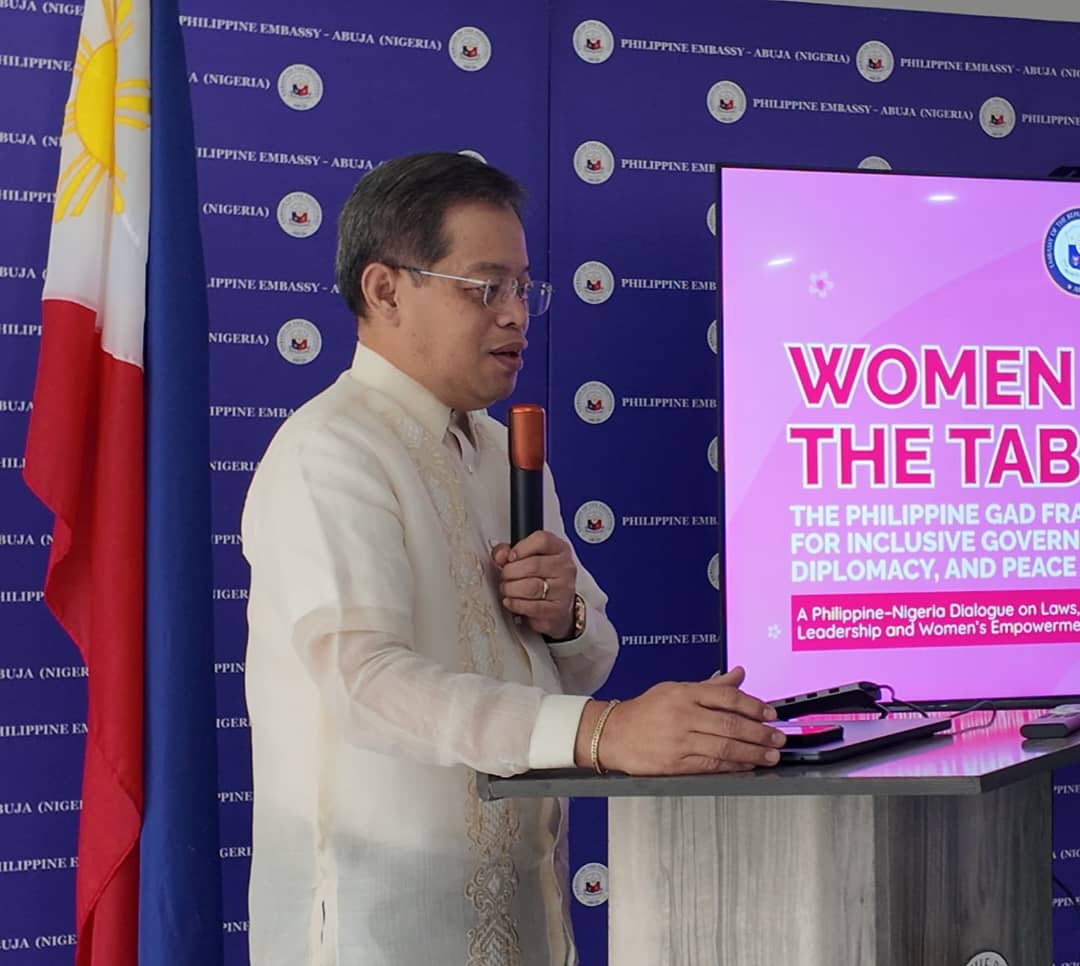
Philippine Ambassador to Nigeria, Mersole Mellejor, made the call in Abuja during a high-level dialogue organised under the Female Legislative Mentorship Initiative on Parliamentary Affairs and Diplomacy at the Philippine Embassy.
The envoy’s intervention centred on a key lesson from the Philippine experience: gender mainstreaming must be backed by institutional sanctions and financial consequences if government agencies fail to implement it.
Mellejor explained that the Philippines had developed mechanisms that tie compliance with gender-responsive policies to government funding, making gender mainstreaming a matter of institutional responsibility rather than voluntary commitment.
“In the Philippines, we have parameters in place that carry direct budget implications for government agencies. Failure to implement gender mainstreaming directly impacts an agency’s budgetary allocation, serving as a firm measure to force compliance,” he said.
The Ambassador argued that Nigeria could draw from the Philippine model as it seeks to increase women’s participation in governance, diplomacy, leadership and national development.
He also cited the Philippines’ Safe Spaces Act, which provides legal protection against gender-based harassment and abuse in public places and workplaces. According to him, the legislation demonstrates how governments can translate gender policies into enforceable protections and mechanisms for accountability.
Mellejor spoke during a session themed “Women at the Table: The Philippine Gender and Development (GAD) Framework for Inclusive Governance, Diplomacy, and Peace.” The meeting brought together officials from the Directorate of Parliamentary Affairs, the Ministry of Foreign Affairs, members of the diplomatic community and legislative mentees.
Despite his call for stronger measures, Mellejor commended Nigeria for the progress it has made in advancing gender inclusion, saying the country’s size, diversity and social complexity should not become obstacles to equality.
“As an outsider, I am very encouraged by where Nigeria is in terms of gender initiatives,” he said.
The ambassador maintained that Nigeria’s diversity could become a strength rather than a weakness, particularly if its different social groups were effectively incorporated into national development.
He also identified Nigeria’s youthful population and rapidly expanding digital, creative and technology sectors as major opportunities for economic transformation and deeper cooperation between Nigeria and the Philippines.
The most significant message from the dialogue was the need to close the gap between gender policies and their actual implementation.
Mellejor said sustained progress would require stronger institutional structures, legislative frameworks and accountability measures capable of compelling public institutions to deliver on gender commitments.
Members of the Philippine diplomatic mission, including Vice-Consul Norman and Vice-Consul Yate, also shared experiences from the embassy’s Gender and Development programmes and their implementation in domestic and international engagements.
The dialogue further examined women’s participation in leadership, gender-responsive legislation and peacebuilding, with participants exchanging ideas on how to strengthen institutional support for women seeking leadership positions.
Mellejor expressed optimism that the engagement would lead to stronger partnerships between the Philippine Embassy, the National Assembly and civil society organisations, particularly in using legislation and public policy to advance gender equality.
For Nigeria, the Philippine model presents a potentially significant policy lesson: gender equality may require not only laws on paper, but measurable institutional obligations backed by consequences for non-compliance.
