


Borno State Governor, Prof. Babagana Zulum, has rallied Nigeria’s neighbours and key diplomatic partners to forge a stronger regional security alliance against Boko Haram, the Islamic State West Africa Province (ISWAP) and other terrorist groups threatening the stability of the Sahel.
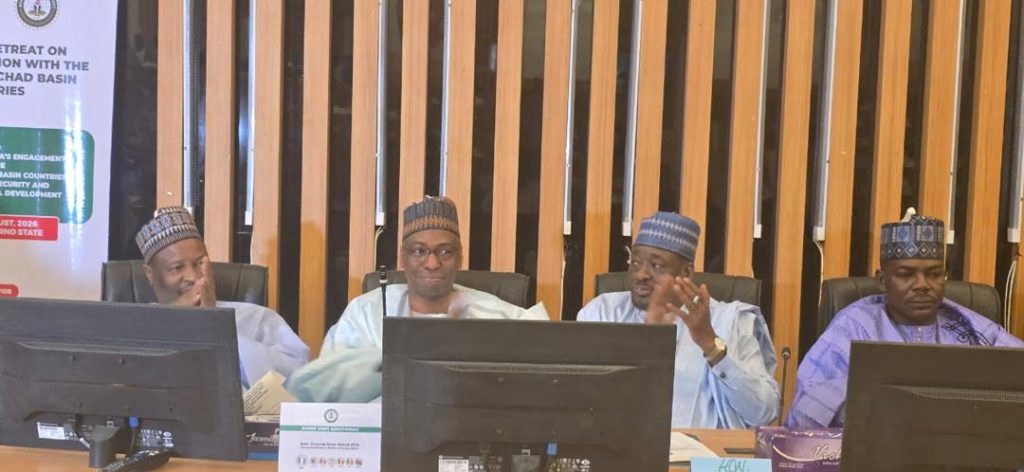
Zulum made the call on Saturday, 8 August, 2026, in Maiduguri at a high-level security retreat attended by representatives of Sahel countries, ambassadors and senior Nigerian foreign-policy officials, where participants warned that terrorism, porous borders, displacement and violent extremism could no longer be confronted through isolated national responses.
The retreat, held at the conference hall of the Musa Usman Secretariat, placed Borno—the epicentre of Nigeria’s more than decade-long battle against Boko Haram—at the centre of renewed efforts to develop a coordinated regional response to the worsening security crisis across the Sahel.
The governor, who has consistently advocated a combination of military operations, humanitarian intervention, economic development and community-based measures, argued that the scale and transnational character of the threat required countries in the region to move beyond fragmented security arrangements.

He said military operations remained indispensable, but stressed that the battle against terrorism could not be won through kinetic operations alone.
According to him, the persistent insurgency and humanitarian crisis in the region demanded a comprehensive strategy capable of addressing both the immediate security threat and the conditions that allow violent extremism to thrive.
“While our armed forces continue their brave operations, we must enhance intelligence sharing, community-based border management, and joint stabilisation initiatives alongside the Multinational Joint Task Force (MNJTF),” Zulum said.
He maintained that stronger cooperation among countries sharing borders and historical ties was critical to preventing terrorists from exploiting territorial and institutional gaps to move fighters, weapons and resources across national boundaries.
The Governor’s position reflects Borno’s experience in dealing with the Boko Haram insurgency, which has devastated communities, displaced millions of people and disrupted livelihoods across the Lake Chad Basin.
Beyond military pressure on terrorist groups, Zulum has repeatedly advocated deradicalisation, rehabilitation and reintegration programmes for repentant insurgents, alongside reconstruction, education, job creation and humanitarian support for affected communities.
He stressed that sustainable peace would require rebuilding communities ravaged by years of violence while restoring confidence between citizens and government institutions.
Earlier, the Minister of State for Foreign Affairs, Mr Sola Enikanolaiye, called for deeper regional cooperation to confront terrorism and other security threats confronting the Sahel.
Enikanolaiye said governments in the region must look beyond military responses and pay greater attention to the underlying conditions that fuel violent extremism, including poverty, unemployment, marginalisation and weak development structures.
He said a coordinated regional strategy would strengthen the capacity of affected countries to prevent terrorist groups from exploiting their borders and local grievances.
Also speaking, the Permanent Secretary, Ministry of Foreign Affairs, Dunoma Umara, underscored the strategic importance of peace and stability in the Sahel to Nigeria’s national interests.
Umara noted that Nigeria’s historical, cultural, economic and geographical ties with the region meant that instability in neighbouring countries would inevitably have implications for Nigeria’s security and economic prosperity.
He therefore called for sustained diplomatic and security engagement among countries in the region, stressing the need to strengthen existing mechanisms for cooperation.
The Ambassador of Chad to Nigeria, Brah Mahamat, also delivered a strong appeal for collective action, warning that differences in regional institutional affiliations must not be allowed to undermine the common fight against terrorism.
He said terrorist organisations do not recognise the political and institutional boundaries that divide countries in the region.
“Although we belong to different institutional groupings, this should in no way impede our common security. Let us be clear: the enemy cares little whether we belong to CEMAC, ECOWAS or the AES. Its aim is to continue slipping across our borders, exploiting the operational limitations we have imposed upon ourselves,” Mahamat said.
His remarks highlighted one of the major challenges confronting the region: the ability of terrorist networks to exploit gaps in border security and differences in political and security arrangements among neighbouring states.
The retreat therefore provided an opportunity for participating countries and diplomatic representatives to examine ways of improving intelligence cooperation, securing borders, strengthening joint military operations and developing stabilisation programmes for communities affected by terrorism.
The discussions also underscored the importance of the Multinational Joint Task Force, which brings together countries of the Lake Chad Basin in the fight against Boko Haram and associated terrorist organisations.
With terrorist networks increasingly operating across national boundaries, participants stressed that regional security cooperation must evolve alongside the threat.
For Borno, the retreat carries particular significance. Maiduguri has endured years of Boko Haram attacks and remains a key centre for Nigeria’s counter-insurgency operations in the Lake Chad Basin.
The decision to convene senior regional and diplomatic stakeholders in the city signals an effort to transform Borno from merely a frontline theatre of the insurgency into a platform for regional dialogue on how to end it.
The emerging consensus from the retreat was that defeating terrorism in the Sahel requires more than battlefield victories. It demands sustained intelligence cooperation, secure borders, resilient communities, economic opportunities, humanitarian assistance and coordinated political action.
As terrorist groups continue to exploit instability across the region, the challenge before Nigeria and its neighbours is increasingly clear: build a common security architecture capable of preventing the Sahel from becoming an even deeper theatre of transnational terrorism.
