


By Umar Usman Duguri
Nigeria’s health sector has rarely suffered from a shortage of policies. Its deeper problem has been the persistent gap between policy and delivery.
For decades, governments have announced programmes, commissioned facilities and launched initiatives, yet millions of Nigerians have continued to confront inadequate primary healthcare, shortages of health professionals, weak emergency response systems and limited access to specialised medical services.
It is against this background that the tenure of Professor Muhammad Ali Pate, Coordinating Minister of Health and Social Welfare, deserves closer examination.

The most compelling feature of Pate’s approach is not any single project. It is the attempt to treat Nigeria’s healthcare crisis as a systemic problem requiring simultaneous reforms in financing, infrastructure, human resources, primary healthcare and service delivery.
That distinction matters.
Beyond the politics of commissioning projects
A health facility is not necessarily a functioning health system.
A hospital building without doctors and nurses is an empty investment. Equipment without trained personnel is underutilised capital. Recruitment without proper deployment creates imbalances. And funding without accountability can disappear without translating into better patient outcomes.
The significance of Pate’s reform agenda therefore lies in its breadth.
Federal health authorities have reported the revitalisation of more than 3,000 primary healthcare facilities nationwide, alongside the training of more than 78,000 frontline health workers.
The numbers are substantial, but the more important question is what they represent: an effort to strengthen the foundation of the health system rather than concentrating resources exclusively in major urban hospitals.
That is strategically important for Nigeria, where the majority of citizens encounter the healthcare system first at the primary-care level.
The workforce question
No health reform can succeed without people.
Nigeria has produced thousands of doctors, nurses, midwives, pharmacists, laboratory scientists and other health professionals, yet inadequate recruitment and difficult working conditions have remained persistent challenges.
The Federal Government has reported the recruitment of more than 20,000 health professionals into federal tertiary institutions, alongside significant investment in training.
The significance of this intervention goes beyond the number of appointments.
Every additional health professional represents increased institutional capacity—provided that recruitment is accompanied by appropriate deployment, equipment, remuneration, supervision and opportunities for professional development.
This is where the long-term test of the reform lies.
The real measure is not simply how many people enter the payroll, but whether hospitals become better staffed and patients receive better care.
And then there is Bauchi
For Bauchi State, Pate’s record has an important additional dimension.
Reports have indicated that more than 3,000 indigenes of Bauchi, and in later accounts nearly 4,000, have benefited from employment opportunities associated with federal health institutions and interventions.
Rather than treating the varying figures as political ammunition, they should be properly reconciled and independently documented.
But even the lower reported figure represents a significant socioeconomic intervention.
Employment in the health sector does not benefit only the individual appointed.
It creates household income, supports dependants, preserves professional skills and contributes to the wider local economy.
For a state with thousands of young graduates searching for opportunities, access to federal employment is therefore a matter of considerable public interest.
The appropriate question is not simply “How many appointments?”
It is:
How many qualified people were recruited, into which institutions, under what process, in which professional categories, and what measurable contribution are they now making to healthcare delivery?
Those are the questions that turn political claims into an accountable public-service record.
Bauchi’s infrastructure story is equally important
Pate’s contribution to Bauchi cannot be reduced to recruitment.
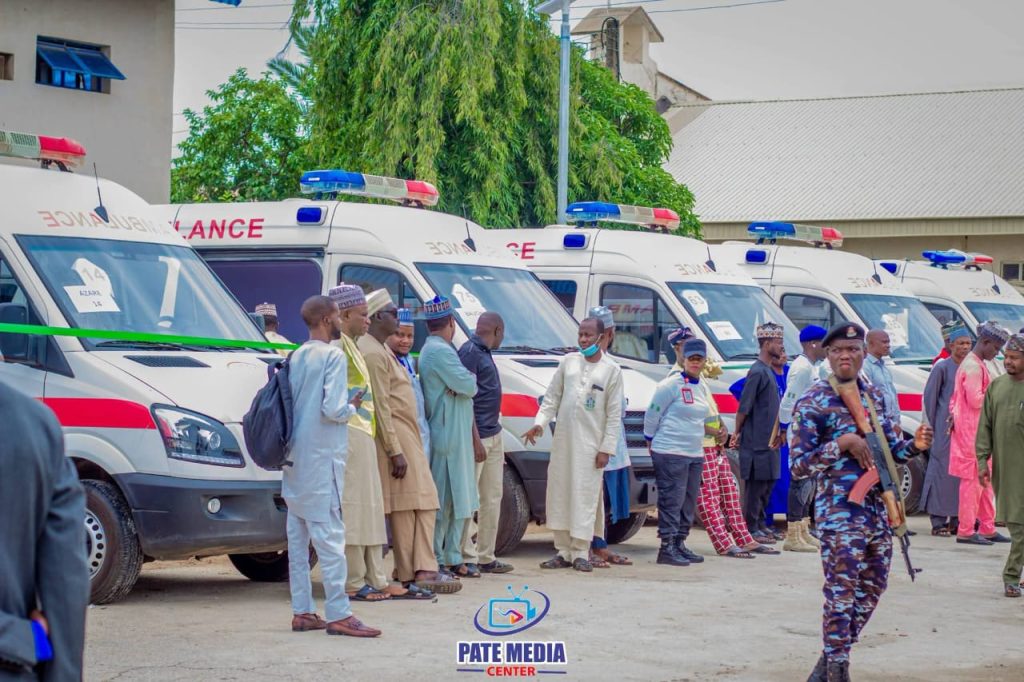
Federal interventions have extended to primary healthcare centres, tertiary institutions, specialist medical services, diagnostic capacity, ambulances and medical equipment.
Facilities such as the National North-East Vesicovaginal Fistula Centre in Ningi and other federal health institutions have featured in the intervention landscape.
But again, the number of projects alone is not the ultimate measure.
The more meaningful indicators are whether patients now have better access to diagnosis, whether referrals are faster, whether specialist services are available locally and whether facilities have the personnel and equipment necessary to remain functional after commissioning ceremonies are over.
This is the difference between infrastructure delivery and health-system transformation.
The maternal-health test
Perhaps the most revealing test of healthcare reform is what happens to a woman experiencing a life-threatening complication during childbirth.
In such circumstances, distance, transportation, trained personnel, blood availability, surgical capacity and referral systems can determine whether a patient survives.
The expansion of emergency medical transport and maternal-health interventions under the federal health-sector renewal programme therefore deserves particular attention.
In Bauchi, federal authorities have reported thousands of beneficiaries of emergency medical services and obstetric fistula interventions.

These interventions should be viewed not merely as government statistics but as indicators of whether the health system is becoming more responsive to emergencies.
Health financing: the reform beneath the reform
One of the less visible but potentially more consequential areas of Pate’s agenda is health financing.
Nigeria cannot build a sustainable healthcare system entirely through occasional capital projects.
Primary healthcare facilities require predictable funding to pay for personnel, medicines, maintenance, utilities and basic operations.
The continuing restructuring and expansion of the Basic Health Care Provision Fund is therefore important because it addresses the financial foundation upon which primary healthcare depends.
The real test, however, will be transparency and sustainability.
Money must reach facilities.
Facilities must remain operational.
Patients must experience improved access.
And the public must be able to follow the money.
A reform that cannot survive changes in political leadership or fluctuations in annual budgets remains vulnerable.
Why the Pate model deserves attention
The broader significance of Pate’s tenure is that it attempts to connect the different parts of the healthcare chain.
Primary healthcare provides the first point of contact.
Trained personnel provide the human capacity.
Hospitals provide secondary and tertiary care.
Emergency transport connects patients to treatment.
Health financing keeps facilities functioning.
Specialist centres address complex conditions.
Data and accountability mechanisms provide the basis for measuring performance.
When these components work independently, the health system remains fragmented.
When they are deliberately connected, the possibility of systemic improvement becomes much greater.
That is the more consequential story behind the reforms.
A minister from Bauchi, but a national responsibility
There is understandable interest in what a federal minister delivers to his home state.
Bauchi residents have every reason to scrutinise employment opportunities, infrastructure and federal interventions reaching the state.
But Pate’s responsibilities are ultimately national.
His most enduring contribution will not be measured by the number of projects associated with Bauchi alone. It will be measured by whether the reforms strengthen Nigeria’s health institutions sufficiently to continue delivering results after the current administration and its ministers have left office.
That is the difference between a political achievement and an institutional legacy.
Commendation should strengthen accountability, not weaken it
There is nothing contradictory about recognising public-sector achievements while demanding greater transparency.
Indeed, genuine commendation should be evidence-based.
The reported recruitment figures should be reconciled.
Beneficiaries should be identifiable.
Projects should be physically verified.
Facilities should be assessed after commissioning.
Health outcomes should be tracked.
And public expenditure should remain open to scrutiny.
If the reforms deliver the improvements promised, the evidence will make the case more convincingly than political slogans ever could.
The record deserves to be documented
Professor Muhammad Ali Pate’s tenure has produced a substantial health-sector reform agenda spanning primary healthcare, workforce development, financing, emergency services, infrastructure and specialist care.
For Bauchi, the reported employment of thousands of indigenes adds a significant socioeconomic dimension to that record.
But the strongest case for recognition is not the repetition of figures.
It is the emerging architecture behind them.
A stronger primary healthcare network.
A larger health workforce.
Greater attention to emergency response.
Improved specialist capacity.
New investment in health infrastructure.
And an attempt to place financing and accountability at the centre of healthcare delivery.
These are the elements that should define the public conversation.
Professor Pate’s record should therefore be subjected to the highest standard of public scrutiny—not because achievements should be diminished, but because documented success deserves to become institutional success.
For Bauchi and for Nigeria, the task now is clear: verify the gains, measure the outcomes, correct the gaps and preserve what works.
That is how public service becomes legacy.
