


As Nigeria’s economy becomes increasingly dependent on digital connectivity, public commentator and legal practitioner, Barnabas Hunjo, has called for greater involvement of communities and ordinary citizens in protecting the infrastructure that supports the country’s growing digital economy.
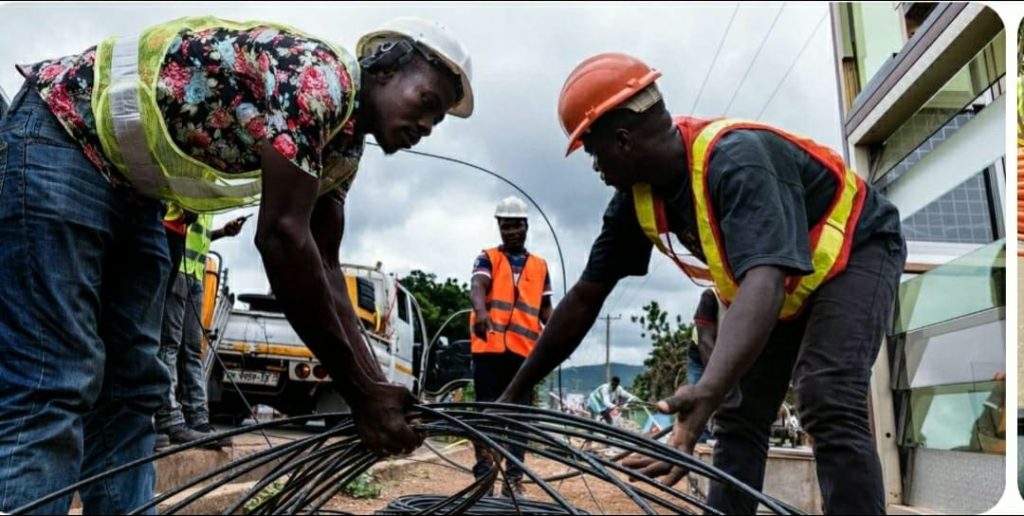
Hunjo said the responsibility for safeguarding telecommunications infrastructure should not rest solely with operators, regulators and security agencies, arguing that Nigerians who live and work around telecom facilities also have a role to play by identifying and reporting threats.
“We cannot keep quiet. We must also understand that our lives depend, our businesses, virtually like they say, data is life,” Hunjo said.
He was speaking against the backdrop of growing concern over damage to fibre-optic cables and other telecommunications facilities, which experts say can have consequences far beyond the immediate disruption of telephone and internet services.
According to him, modern economic activity is now heavily dependent on connectivity, covering banking, point-of-sale terminals, ATMs, internet services, ports, aviation and virtually every business.
“When we talk about telecommunications infrastructure, we have to understand that modern economies depend heavily on connectivity,” the telecommunications analyst added.
The growing dependence is reflected in the scale of Nigeria’s telecommunications market. Nigerian Communications Commission (NCC) data put active telephone subscriptions at 195.1 million in July 2026, while 4G and 5G accounted for 54.31 per cent and 4.74 per cent respectively of subscribers by network generation.
The physical infrastructure supporting that connectivity has also become more extensive and more economically significant. It includes base stations, fibre-optic cables, data centres, submarine cables and internet landing points.
The Federal Government designated relevant information and communications technology systems, networks and infrastructure as Critical National Information Infrastructure under a Presidential Order published by the NCC in November 2024. The order seeks, among other objectives, to reduce incidents capable of damaging or disrupting such infrastructure and ensure its continued operation because of its importance to economic development, national security, public health and government operations.
Yet protecting the infrastructure remains a challenge.
The NCC disclosed in August that more than 5,000 fibre-cut incidents were recorded in the first six months of 2026, with road construction, excavation and related civil works identified among the causes. The Commission said such damage could disrupt banking, government services, education, healthcare, commerce, security and emergency communications.
For communities, the consequences can be immediate. A damaged fibre route may affect connectivity well beyond the location where the cable was cut, disrupting businesses and digital services that depend on the network.
The NCC has therefore increasingly framed infrastructure protection as a collective responsibility. In an earlier sensitisation programme, the Commission called on citizens, communities and traditional leaders to work with operators and security agencies to protect telecommunications facilities, citing the implications for service quality and economic development.
The call also fits into a broader government effort to prevent rather than merely repair damage.
In February 2025, the Federal Ministry of Works and the Federal Ministry of Communications, Innovation and Digital Economy established a Joint Standing Committee on the Protection of Fibre Optic Cables, with the NCC involved, to improve coordination before, during and after road construction and rehabilitation works.
The committee was tasked with developing communication channels between road authorities and telecom operators, while the government said fibre placement should be considered during road planning and construction, including provision for ducts.
The NCC subsequently said the committee had been expanded to include the Office of the National Security Adviser, reflecting the security implications of protecting infrastructure classified as critical national infrastructure.
Hunjo, however, believes institutional action needs to be complemented by public vigilance.
He said government agencies also needed to clearly define their respective responsibilities so that reports of threats could be quickly directed to the appropriate authority.
“We need to come up with a breakdown of who does what, and how do we respond quickly to threats affecting this critical infrastructure,” he said.
He added that Nigeria already had laws capable of dealing with damage to telecommunications infrastructure, but effective enforcement depended on the ability of institutions to detect threats, respond to them and prosecute offenders where appropriate.
The need to protect the infrastructure is becoming more significant as operators continue to invest heavily in network expansion.
MTN Nigeria reported that its capital investment exceeded N1 trillion in 2025, representing a 126.2 per cent increase, while the company says its fibre network now extends beyond 43,000 kilometres and serves more than 13,000 businesses.
Such investments form part of a wider expansion of Nigeria’s digital infrastructure, but their economic value depends partly on the reliability and security of the networks being built.
The issue is therefore not simply about preventing vandalism or cable theft. It also concerns how Nigeria protects infrastructure that increasingly enables financial transactions, commerce, communication, public services and access to digital opportunities.
Hunjo also urged telecom operators to work together and engage government more actively, including through greater coordination and sharing of resources.
He said operators were already collaborating in some areas, including infrastructure sharing, but needed to continue working collectively while encouraging government to act faster on the protection framework.
For communities, the role may be less about physically guarding telecom assets than recognising their importance and reporting suspicious activity, damage or threats to the appropriate authorities.
That distinction is important because the country’s growing digital dependence means telecom infrastructure is no longer an invisible industry asset. It is increasingly part of the infrastructure through which Nigerians conduct business, access financial services and communicate.
As the volume of digital activity grows, Hunjo’s argument places a new emphasis on community ownership: if the networks support the wider economy, protecting them is not only an operator’s responsibility, but a shared public interest.
