


The Central Bank of Nigeria’s ambition to make the country’s payment system faster, more reliable and less prone to failed transactions by 2028 is running into a persistent infrastructure problem, with telecom operators recording 5,934 fibre-optic cable cuts in the first quarter of 2026 alone.
The figure, obtained from the Nigeria Communications Commission’s network outage data, translates to about 65 fibre cuts every day, or roughly one every 22 minutes, highlighting the vulnerability of the connectivity infrastructure supporting banks, fintechs, payment processors and businesses.
The scale of the infrastructure disruption comes as the value of electronic payments continues to rise. Data from the CBN’s Q1 2026 Statistical Bulletin showed that electronic transactions across six major channels were valued at N1.053 quadrillion in the first quarter, up 2.85 per cent from N1.024 quadrillion in the corresponding period of 2025.
At the same time, the number of transactions across the six channels fell 9.19 per cent year-on-year to 12.57 billion from 13.84 billion, meaning that a larger value of money was moving through the electronic payment system even as transaction volume declined.
The six channels covered by the CBN data are cheques, automated teller machines, point-of-sale terminals, Web Pay, Mobile Pay and Nigeria Instant Payment.
The development gives added significance to the CBN’s Payments System Vision 2028, launched in June with the stated objective of building a secure, inclusive, innovative and interoperable payments ecosystem. The framework places infrastructure, interconnectivity and interoperability among its central priorities.
In its subsequent consumer education campaign on PSV 2028, the CBN specifically linked stronger payment infrastructure and interconnectivity with faster transactions, fewer failed transactions and more reliable payment services.
But while the CBN is seeking greater reliability within the payment architecture, the telecommunications infrastructure carrying connectivity to many of the participants in that ecosystem remains exposed to repeated physical disruption.
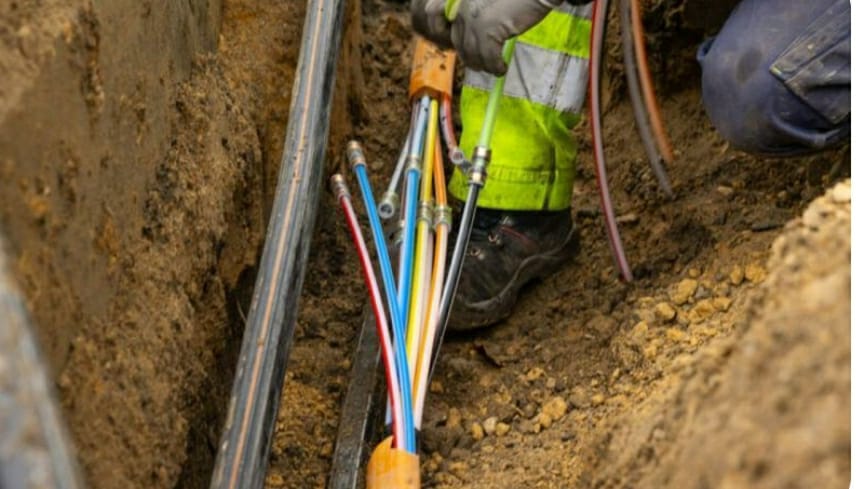
NCC data reported for the first quarter showed 5,934 fibre-cut incidents across mobile network operators and internet service providers. The reported causes included infrastructure degradation, road construction, cable damage, vandalism, surface cable damage and other physical factors.
The problem is not confined to telecommunications customers. NCC Executive Vice-Chairman and Chief Executive Officer, Aminu Maida, said at a stakeholders’ workshop in Abuja in August that fibre damage could result in “payments blocked” and other essential services being interrupted.
Maida said more than 5,000 fibre-cut incidents had also been recorded during the first six months of 2026 from road construction, excavation and related civil works, attributing many incidents to inadequate coordination before construction activities began.
The two figures are not contradictory: the 5,934 incidents reported for the first quarter cover all reported fibre-cut incidents, while Maida’s August disclosure referred specifically to more than 5,000 incidents during the first half associated with road construction, excavation and related civil works.
The infrastructure problem also extends beyond fibre routes. Nigeria’s electronic payment system relies on several interconnected layers, including telecommunications networks, payment switches, bank and fintech platforms, data centres, power infrastructure and merchant devices.
A disruption at one point does not necessarily mean that a payment will fail because operators can reroute traffic and payment providers can maintain alternative connections. But repeated physical damage increases the pressure on the redundancy built into the wider system.
The CBN has already moved to address part of that vulnerability within the payments architecture.
In December 2025, the apex bank directed payment acquirers, processors and payment terminal service providers to maintain active connectivity with both the Nigeria Inter-Bank Settlement System and Unified Payment Services Limited.
The directive provides for automatic failover and periodic testing of the alternative connection, reducing dependence on a single payment-switching route.
The measure is significant because it recognises that continuity cannot depend on a single pathway. But it addresses resilience at the switching and transaction-processing layer, rather than eliminating the physical vulnerability of the telecommunications networks connecting financial institutions, merchants and consumers.
The distinction matters as electronic payments become a larger part of economic activity.
NIBSS data showed that Nigeria processed more than 11.2 billion electronic transactions worth over N1.07 quadrillion in 2024, demonstrating the scale already reached by the country’s digital payments ecosystem.
The latest CBN figures suggest that the system is continuing to handle enormous values even as the composition of transactions changes. Mobile Pay volume, for instance, rose 28.60 per cent year-on-year in Q1 2026 to 2.67 billion transactions, while NIP volume fell 17.70 per cent to 1.82 billion even as the value of NIP transactions increased 12.55 per cent to N320.76 trillion.
Web Pay remained the largest channel by value at N529.82 trillion, despite a 14.14 per cent decline in transaction volume, while POS transactions fell 19.90 per cent in volume to 2.92 billion and 16.42 per cent in value to N59.33 trillion.
The figures underline how heavily different parts of the economy now depend on digital payment infrastructure, even though the channels through which transactions occur continue to shift.
The fibre problem is therefore not simply a question of dropped calls or slower internet services. When connectivity is disrupted, the consequences can extend to digital banking, merchant payments, business communications and other services that depend on real-time network access.
That vulnerability was demonstrated in March 2024 when faults affecting major subsea cables disrupted internet connectivity across parts of West Africa, including Nigeria. The episode exposed the consequences of concentration in critical connectivity infrastructure and reinforced the importance of alternative routes and redundancy.
The more persistent challenge, however, is occurring on land.
Road construction and excavation have become recurring sources of fibre damage, according to the NCC’s recent disclosures. At its August workshop, the commission called for closer coordination between telecom operators, construction companies, engineers and other stakeholders to prevent damage to buried fibre infrastructure.
The NCC’s network-outage data also showed 577 network outages in the first quarter, with 361 attributed to fibre cuts and 144 to power outages, according to reports based on the commission’s monitoring portal.
That distinction is important. The 5,934 figure represents fibre-cut incidents, while the 361 figure represents outages in which fibre cuts were identified as the cause. A fibre cut therefore does not automatically translate into a network-wide outage, just as a network outage does not automatically mean that an electronic payment has failed.
But the frequency of the physical disruptions leaves financial institutions and payment providers with a continuing resilience challenge.
For the CBN, PSV 2028 raises the standard against which that resilience will increasingly be judged. Its official vision calls for a payment system that is secure, inclusive, innovative and interoperable, while the central bank says its infrastructure and interconnectivity agenda is intended to make payments more reliable and reduce failures.
For the telecom sector, the numbers point to a different test: whether the country can expand its digital economy without allowing the physical infrastructure underneath it to remain routinely vulnerable to construction damage, degradation and vandalism.
Nigeria is therefore pursuing two related objectives at the same time — a payment system expected to become increasingly dependable by 2028 and a communications network that continues to experience thousands of physical disruptions.
The success of the first will depend partly on how effectively the second is made more resilient.
