



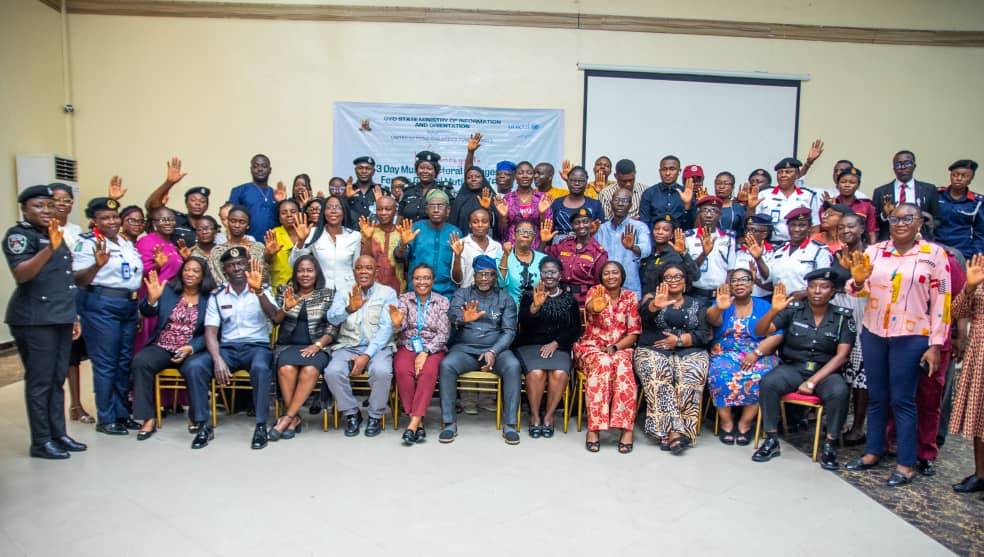
In a major step towards eradicating Female Genital Mutilation (FGM) in Southern Nigeria, the Oyo State Government, in partnership with the United Nations Children’s Fund (UNICEF), has called for a strengthened prosecution of Female Genital Mutilation, (FGM) cases across Edo, Ekiti, Osun, Ondo, and Oyo States.
This submission was upheld at a 3-day Multi-sectoral Engagement meeting which brought together law enforcement officials, judicial actors, NGOs, government agencies and religious leaders.
The workshop is focused on improving justice system responses and survivor-centered approaches in addressing FGM held at Ibeju-Lekki, Lagos State.
In his opening remarks, the Permanent Secretary, Oyo State Ministry of Information, Mr Rotimi Babalola,who represented the Commissioner, Prince Dotun Oyelade described the engagement as “apt and timely,” citing the continued prevalence of FGM despite the existence of relevant laws such as the Violence Against Persons (Prohibition) Act (VAPP) and the Child Rights Law.
He pointed out that all five states already have legal frameworks in place, such as the Violence Against Persons (Prohibition) Act (VAPP) and the Child Rights Law, which criminalize the practice. However, low levels of reporting, weak enforcement, inadequate survivor-centered responses and fragmented inter-sectoral collaboration have continued to limit their effectiveness.
Mr. Babalola commended UNICEF for initiating the workshop, noting that it brings together critical stakeholders including law enforcement officers, judicial officials, NGOs, government agencies, and religious institutions. The aim, he said, is to bridge existing gaps in FGM response through enhanced capacity building, timely case documentation, protection of survivors and prosecution of offenders.
“The goal is clear, which is to enhance FGM reporting, ensure survivor protection, and strengthen the justice system through improved multi-sectoral collaboration,” he said.
The workshop is expected to improve participants’ knowledge of FGM laws, survivor-centered responses, and reporting procedures. It also aims to establish and strengthen coordination mechanisms among the law enforcement, health, social welfare, and justice sectors.
He urged participants to propose actionable strategies, strengthen inter-agency coordination, and critically review existing enforcement gaps that hinder progress in ending FGM. He also expressed gratitude to UNICEF and implementing partners for their swift coordination and support for the workshop.
“I am confident that with the calibre of attendees at this workshop, we shall have a successful outing and make significant progress in our collective efforts to eliminate FGM—for the future of the girl-child, who will grow up to become a mother in our society,” he added.
Speaking at the event, the UNICEF Child Protection Specialist, Mr. Denis Onoise emphasized the urgency of eliminating the harmful practice, outlining the four types of FGM: clitoridectomy, excision, infibulation, and unclassified forms.
Despite the adoption of laws like the VAPP Act in many states, Onoise noted that prosecutions are rare, and communities are reluctant to report cases. He therefore called for stronger legal enforcement, greater budgetary commitments for anti-FGM programs, and the continued engagement of traditional leaders and men led advocacy groups.
While noting progress through the adoption of the Violence Against Persons Prohibition (VAPP) Act and advocacy campaigns, Onoise said prosecutions are rare and communities still hesitate to report cases.
He urged state House of Assemblies, law enforcement and the justice sectors to take stronger action, including prosecuting offenders and increasing budget allocations for FGM programs. He also commended traditional leaders and men’s advocacy groups who are taking steps to abandon the practice.
“Our goal is clear, we need to increase our steps ten times beyond what we are doing now to eradicate FGM in our States by 2030,” he said.
Also speaking, the Executive Director of Trailblazer Initiative, Dr Dare Adaramoye called for the establishment of specialized courts to handle gender-based violence cases, including FGM. He highlighted the serious gaps in the reporting and justice chains that allow perpetrators to go unpunished.
He noted that while many states have adopted the Violence Against Persons Prohibition (VAPP) Law, prosecution of offenders remains weak.
“We’ve identified a serious gap in the chain of reporting and justice. It’s high time the law took its full course and perpetrators are held accountable,” he said.
He called for stronger collaboration between communities, social services, and justice institutions, as well as specialized courts to fast-track cases on violence against women and children.
The workshop is expected to improve knowledge of FGM laws and reporting procedures, Strengthen coordination across law enforcement, health, welfare, and justice sectors, enhance survivor protection and prosecution outcomes,
as well promote sustained community engagement against FGM.
This initiative reinforces the shared commitment of government, international partners and civil society to eliminate all forms of gender-based violence, particularly those targeting girls and women, and to uphold their rights, dignity, and future.
“FGM does not prevent promiscuity. It is not culture. Give your girl child education, not mutilation,” he emphasized.
